Share this post
The global Industry 4.0 market hit $205.91 billion in 2025 and is projected to reach $801.49 billion by 2034. So, spending is clearly not the problem. Yet according to WEF, at least 70% of manufacturers remain stuck in “pilot purgatory”, unable to scale digital initiatives beyond a single line or factory.
The gap between investment and results comes down to implementation. Knowing which technologies to adopt, how to sequence them, where teams typically get stuck, and what separates a pilot that scales from one that doesn’t.
This guide covers all of it: what Industry 4.0 actually is, the core technologies behind it, a step-by-step implementation framework, real-world examples with measurable outcomes, and the challenges that derail adoption in practice.
What Is Industry 4.0?
Industry 4.0 is digital transformation applied to manufacturing. It connects machines, systems, and data across the factory floor to enable real-time decision making, higher productivity, and operational agility. It's the fourth industrial revolution, and it follows a clear progression.
The first revolution introduced mechanization through steam and water power. The second brought mass production through electricity and assembly lines. The third added computers and automation to production lines.
The biggest difference between 3.0 and 4.0 is that the former gave you automation in isolation. Machines and sensors did their jobs, but they had no way to share data across the floor. The latter turns them into a single system.
Technologies like industrial IoT, AI, edge computing, and digital twins connect those systems so that a production line can spot a defect before it leaves the floor, predict maintenance needs, and automatically feed performance data back to planning systems.
The Technologies That Make Industry 4.0 Possible
Industry 4.0 is built on a stack of technologies, where the true value comes from how they work together. Here are the core innovations that make it work.
1. Industrial IoT (IIoT) Sensors and Devices
IIoT is the data collection layer. Sensors attached to machines, production lines, and infrastructure capture everything from vibration and temperature to pressure, throughput, and energy consumption. That data is what the rest of the stack runs on.
Without IIoT, there’s nothing to analyze, predict, or optimize. 72% of large manufacturers already have at least one IIoT pilot or production deployment. The challenge is to deploy sensors and ensure the data they generate reaches the systems that can use it. This is also why IoT device management is so important.
2. Edge Computing
Edge computing brings data processing directly to the factory floor rather than routing everything through a centralized cloud. That means faster decisions, lower latency, and systems that keep running even when connectivity drops.
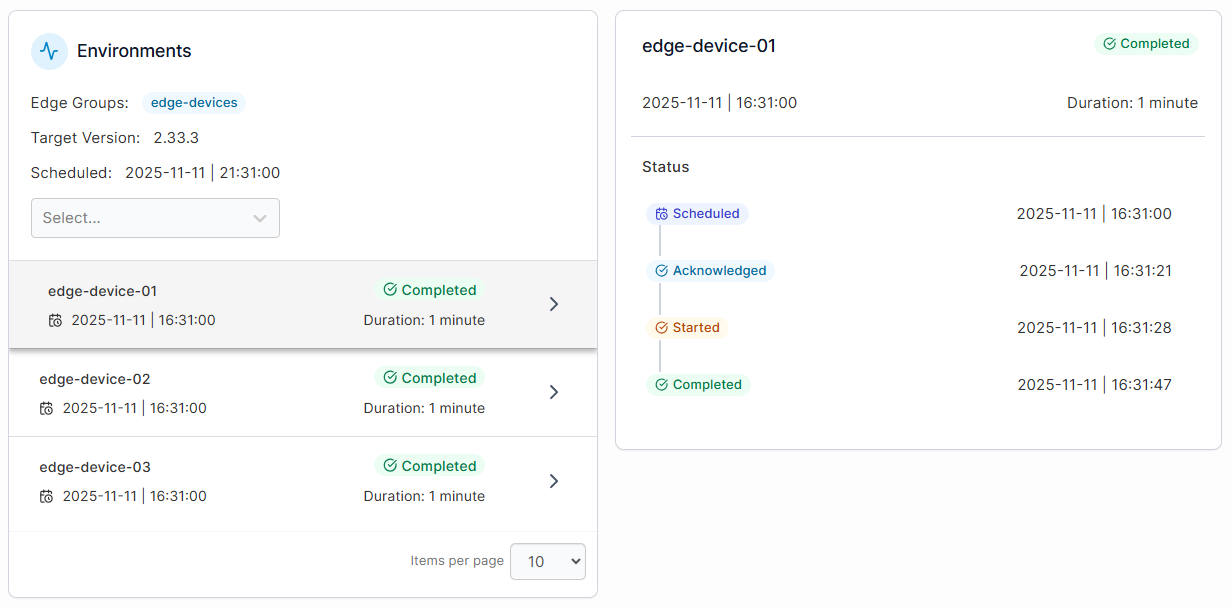
Edge computing platforms handle time-sensitive workloads locally while pushing historical data and analytics to the cloud for longer-term analysis. For manufacturers running Kubernetes at the edge, this also means managing containerized applications across dozens or hundreds of remote nodes.
3. Artificial Intelligence and Machine Learning
AI and ML sit atop the data provided by IIoT and edge computing. Their job is pattern recognition at a scale no human team can match.
In manufacturing, the practical applications include:
- Predictive maintenance: flagging a failing bearing weeks before it causes a line stoppage based on vibration and temperature trends.
- Automated quality inspection: using computer vision to catch defects faster and more consistently than manual checks.
- Process optimization: adjusting machine parameters on the fly to reduce waste, energy consumption, and cycle times.
4. Digital Twins
A digital twin is a virtual replica of a physical asset, production line, or entire factory. It uses live data from IIoT sensors to mirror real-time conditions, so engineers can simulate changes, test scenarios, and spot problems before they happen on the actual floor.
The digital twin market is projected to grow from $28.9 billion in 2025 to $122.24 billion by 2030, driven largely by manufacturing use cases. In practice, a digital twin lets a plant manager ask “what happens if we increase line speed by 15%?” and get an answer from the simulation instead of risking a production disruption to find out.
5. Autonomous Robots and Cobots
Autonomous robots handle tasks like material transport, palletizing, and inventory scanning with minimal human input. Cobots, or collaborative robots, work alongside operators, assisting with repetitive or precision-heavy tasks like assembly, welding, or machine tending.
What makes both of these relevant to Industry 4.0 is their connectivity. They pull real-time instructions from the same IIoT and edge computing layer that feeds the rest of the stack.
For example, a cobot adjusting its grip pressure based on live sensor data from the part it’s handling is Industry 4.0 in action. A robot following a fixed program regardless of what’s happening around it is Industry 3.0.
6. Additive Manufacturing (3D Printing)
3D printing allows manufacturers to produce parts by adding material layer by layer from a digital file, rather than machining or casting from raw stock. This changes the economics of low-volume and custom production significantly:
- On-demand spare parts: store digital files instead of physical inventory, and print when needed.
- Faster prototyping: cycles that used to take weeks shrink to days.
- Design freedom: complex geometries that are impossible with traditional tooling become standard.
For Industry 4.0 teams, 3D printing also ties directly into the digital twin layer. You can simulate a design change, validate it virtually, and print the updated part without retooling an entire line.
7. Cloud and Hybrid Infrastructure
Cloud provides the centralized compute, storage, and analytics backbone that ties everything together. The raw data you get from edge nodes flows into cloud-based data lakes for historical analysis, reporting, dashboards, and ML model training.
In manufacturing, though, hybrid setups are more common. Sure, some workloads run on-prem, others in the cloud, but not everything can or should depend on an internet connection.
8. Containerization and Orchestration
Containers package applications and their dependencies into portable, consistent units that run the same way everywhere (edge, on-prem, or cloud). Container orchestration platforms like Kubernetes manage the deployment, scaling, and lifecycle of those containers across environments.
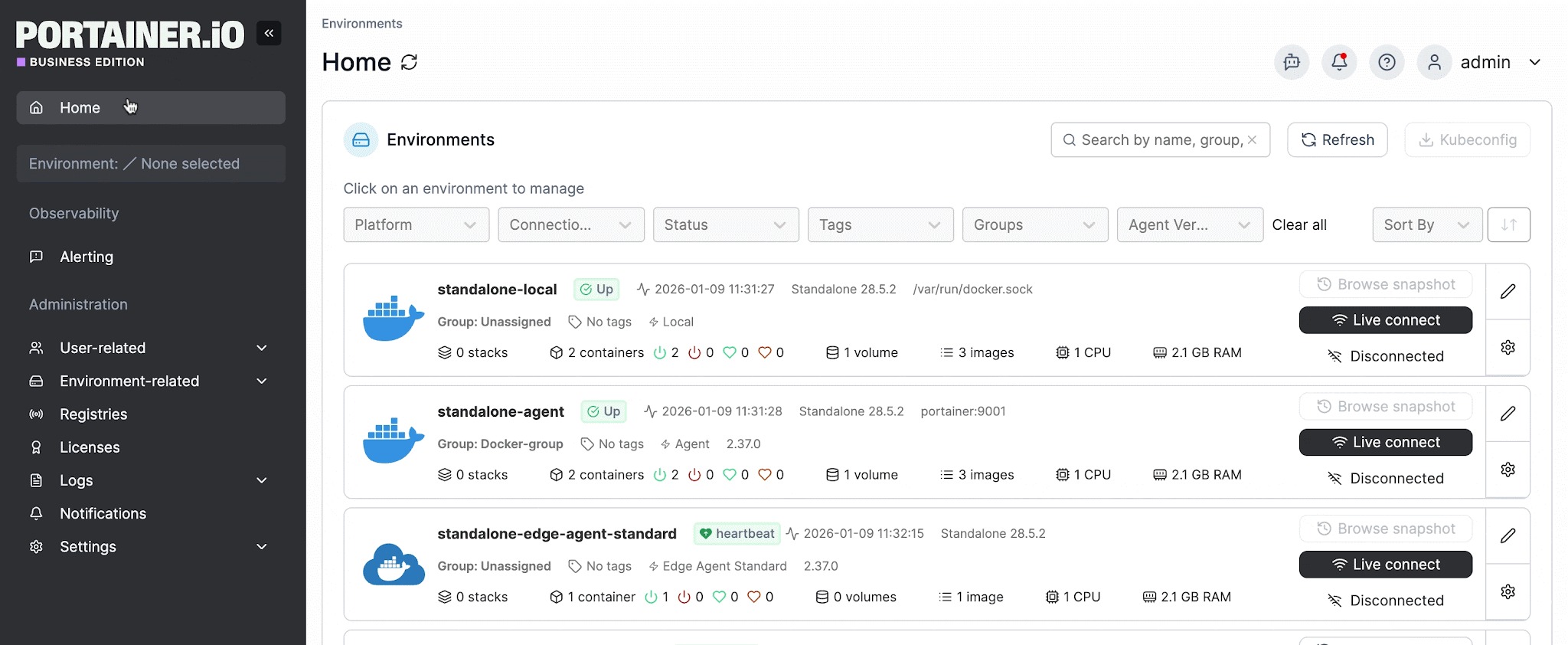
For Industry 4.0 teams, this is what makes the software layer manageable. Instead of manually configuring applications on every device at every site, containerized workloads can be deployed, updated, and rolled back centrally. Tools like Portainer give teams a single UI to manage that process across every environment.
9. Cybersecurity
Every connected sensor, edge node, and cloud endpoint is a potential attack surface for bad actors. And as factories become more connected, the stakes get higher. A compromised production system can halt an entire line, corrupt quality data, or create safety hazards.
Industry 4.0 cybersecurity includes:
- Zero-trust architectures that verify every connection, every time.
- Network segmentation between IT and OT systems to contain breaches.
- Encrypted device communication to protect data in transit.
- Role-based access controls that limit who can change what, and where.
This is especially critical for organizations in regulated industries like government, defense, and financial services, where a single breach can trigger compliance violations, operational shutdowns, and reputational damage.
Beyond these core technologies, several others are gaining traction in Industry 4.0 deployments. 5G, for instance, is enabling low-latency wireless communication on the factory floor, augmented and virtual reality are being used for remote maintenance and operator training, and blockchain is finding applications in supply chain traceability and data integrity.
Sure, not all of these are central to every implementation today, but as Industry 4.0 matures, they’re becoming harder to ignore.
{{article-cta}}
Key Strategies for Industry 4.0 Implementation
The single biggest implementation mistake manufacturers make is treating Industry 4.0 as a technology project. It’s, in fact, an operational transformation that happens to use technology. Here’s a framework that sequences the work in the right order.
Step 1: Assess Your Current Maturity
Before buying or connecting anything, you need to know where you stand. The acatech Industrie 4.0 Maturity Index is a widely cited framework for this purpose. It defines six stages of digital maturity:
- Computerization: standalone digital tools exist, but systems operate independently.
- Connectivity: equipment can exchange data, though integration is limited.
- Visibility: sensors and connected systems provide real-time awareness of what's happening on the floor.
- Transparency: data is analyzed to understand why things are happening.
- Predictive capacity: systems can forecast what will happen next.
- Adaptability: systems respond and adjust autonomously.
The important thing to note here is that the jump from Stage 1 to Stage 2 delivers the highest ROI. So knowing which stage you’re at tells you exactly where to focus first, instead of chasing Stage 5 capabilities on a Stage 1 foundation.
Step 2: Define Clear Business Objectives
Industry 4.0 is a means to a specific outcome. So before selecting any technology, define what success looks like in measurable terms:
- Reduce unplanned downtime by X%
- Cut scrap rates by X%
- Improve OEE from X% to Y%
- Lower energy consumption per unit by X%
These objectives determine everything downstream, for example, which technologies you deploy, where you deploy them, and how you measure progress. Without them, you’re just installing sensors and hoping something useful comes out the other end.
Step 3: Start Small With a High-Impact Pilot
The organizations that successfully scale Industry 4.0 almost always start with a single line, a single factory, or a single use case. The goal of the pilot is to ensure it’s delivering measurable business value in your environment, with your team, on your equipment.
To do this, pick a use case where the pain is obvious and the data is accessible. Predictive maintenance on a critical asset, for example, is a common starting point because the costs of downtime are easy to quantify.
From there, deploy the minimum viable stack (IIoT sensors, an edge computing layer, and a dashboard), measure the results over 60 to 90 days, and use the data to build the case for broader rollout.
Step 4: Build the Right Team Structure
Industry 4.0 sits at the intersection of IT and OT, and many organizational structures aren’t set up for that.
You need a cross-functional team that includes operations (who understand the processes), IT (who understand the infrastructure), engineering (who understand the equipment), and at least one executive sponsor who can remove roadblocks and secure budget.
The operational maturity framework matters here. Without clear ownership and governance, Industry 4.0 initiatives get stuck between departments, each waiting for the other to take the lead.
Step 5: Design a Scalable Architecture
What works for one production line needs to work for fifty. The architecture decisions you make during the pilot phase will either enable or block your ability to scale. This means:
- Standardize your data layer. Use consistent protocols and data models across devices and sites so data from one factory can be compared with data from another.
- Build for hybrid. Some workloads belong at the edge, others in the cloud. Design for both from the start.
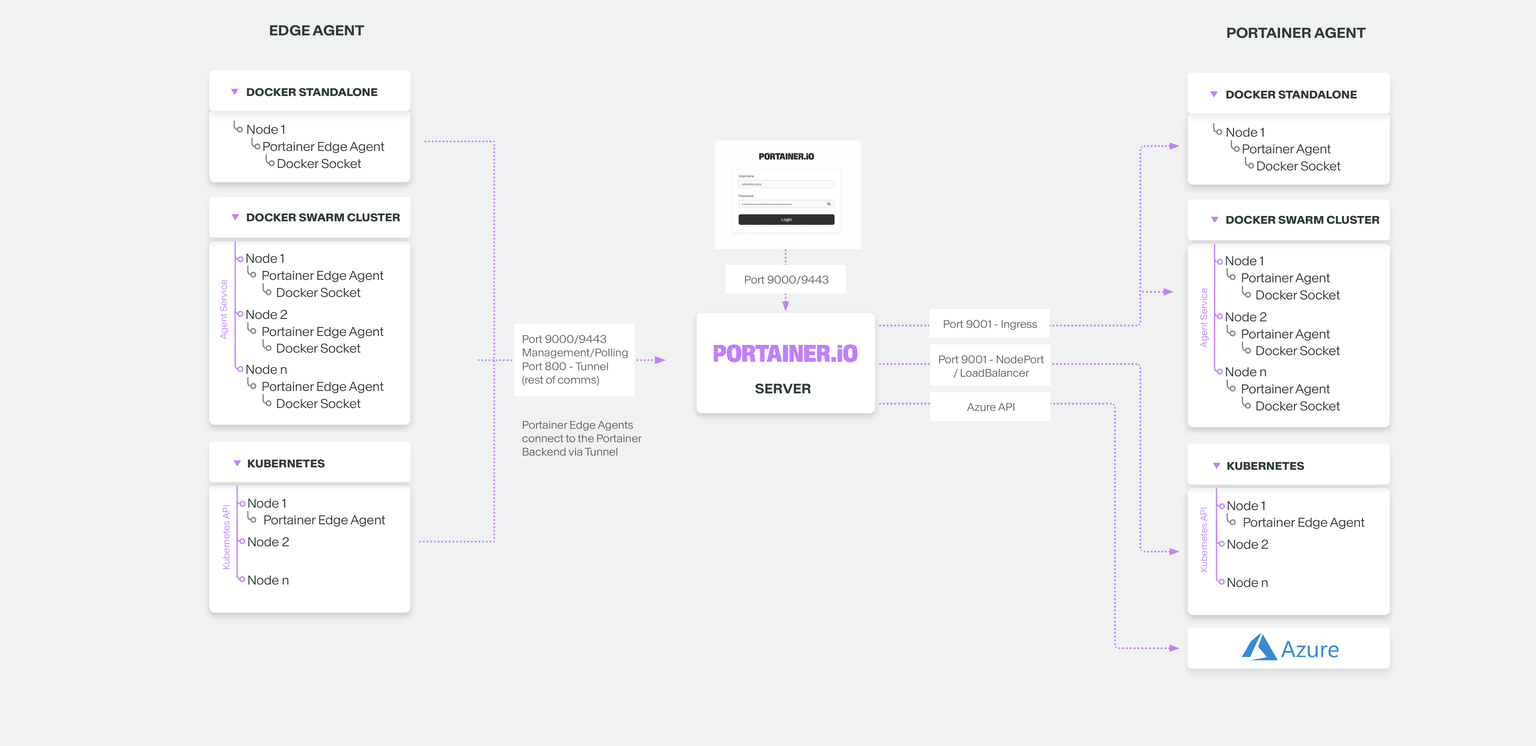
- Containerize your applications. Packaging workloads in containers ensures they run consistently across edge devices, on-prem servers, and cloud instances. A Kubernetes implementation provides the orchestration layer to deploy and manage those containers at scale, and tools like Portainer make it possible to do that without needing deep Kubernetes expertise on every team.
- Plan for multi-site from day one. If your pilot architecture can’t replicate to a second site without rebuilding everything, it's not ready to scale.
Step 6: Integrate IT and OT Systems
The IT-OT gap is where many Industry 4.0 projects stall. Operational technology (PLCs, SCADA, HMIs) and information technology (cloud, databases, analytics) were historically developed and managed by separate teams with distinct priorities. Industry 4.0 requires them to work as one system.
This doesn’t mean ripping out existing OT infrastructure, but building a bridge instead. Using edge gateways, protocol converters, and standardized APIs to get OT data into IT systems without disrupting production.
Keep OT systems doing what they do well (controlling machines) while giving IT systems access to the data they need for analytics, monitoring, and optimization.
Step 7: Iterate, Measure, and Scale
Once the pilot delivers results, the temptation is to jump straight to a full-scale rollout. Resist it. Scale incrementally: expand from one line to a full plant, then from one plant to multiple sites.
At each stage, measure the same KPIs you defined in Step 2 and compare them against the pilot baseline.
The manufacturers that scale successfully treat Industry 4.0 as a continuous improvement cycle, in which each iteration reveals new optimization opportunities, new data sources, and new use cases that feed into the next phase.
Selecting the Right Technologies
The right Industry 4.0 stack depends on what you’re trying to solve. Here’s how to match technology choices to specific use cases.
- Predictive maintenance: if unplanned downtime is your biggest cost driver, start with IIoT vibration and temperature sensors on critical assets, an edge computing layer for real-time processing, and an ML model trained on historical failure patterns. McKinsey data shows this alone can reduce machine downtime by 30 to 50%.
- Quality control and defect detection: if scrap rates or customer returns are the priority, look at computer vision paired with AI models for automated inspection. The key decision is where to run inference: at the edge (faster, works offline) or in the cloud (easier to update models). For high-speed lines, edge is usually the only viable option.
- Energy and resource optimization: if cost reduction and sustainability targets are driving the initiative, focus on real-time monitoring of energy consumption, water usage, and material waste through IIoT sensors and analytics dashboards.
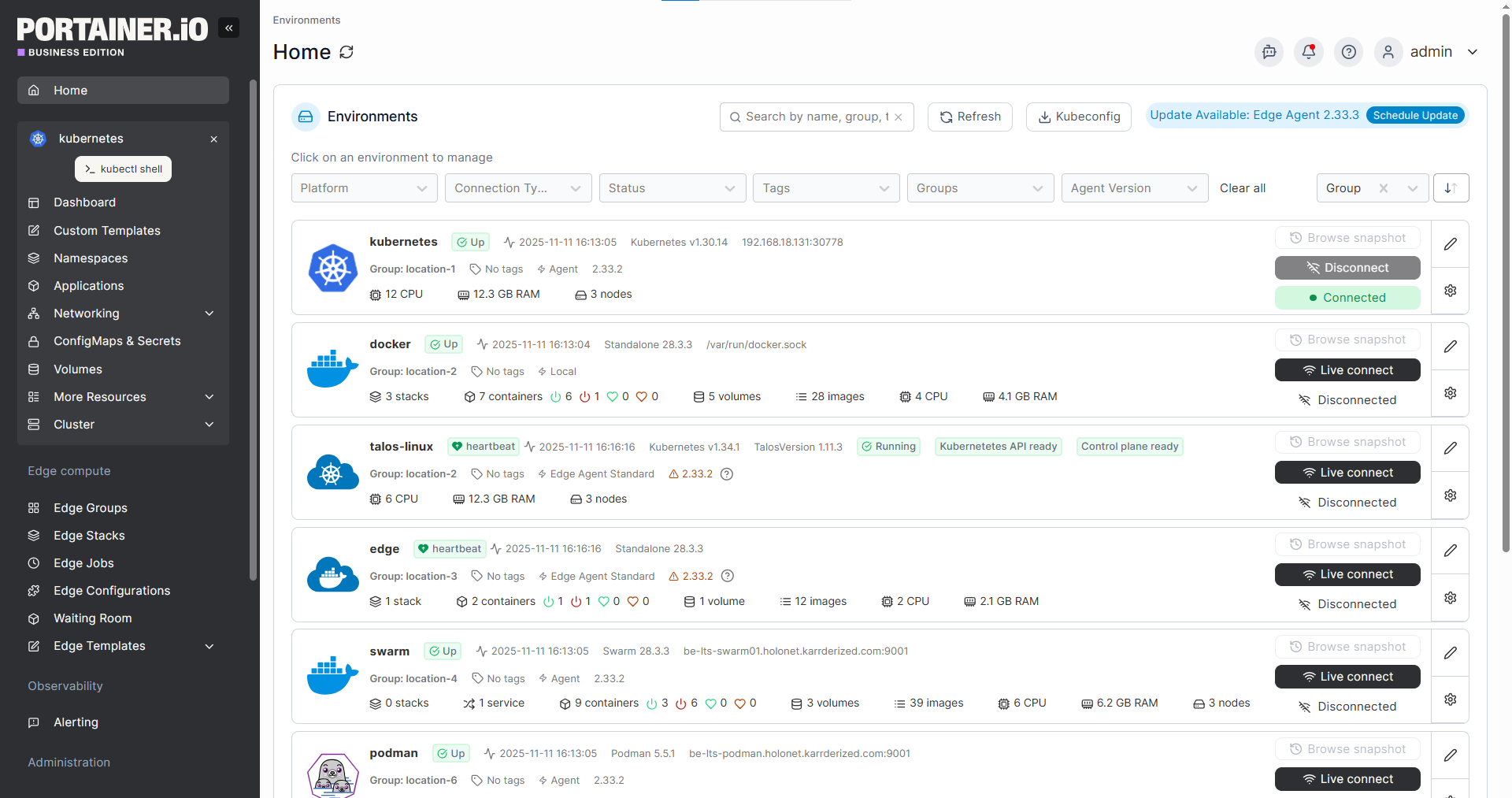
- Multi-site visibility and governance: if the challenge is managing operations across multiple factories, the priority is centralized visibility with consistent access controls and governance. This is where container orchestration and a management layer like Portainer become essential for deploying and monitoring applications across distributed environments from one interface.
- Remote and edge-heavy environments: if your sites have limited connectivity or no on-site IT staff, you need lightweight edge platforms that operate autonomously, sync when connectivity is available, and can be managed remotely. Containerized applications are particularly valuable here because they can be updated and rolled back centrally without requiring an on-site presence.
A Practical Industry 4.0 Implementation Checklist for IoT Teams
If you’re past the strategy phase and ready to execute, here’s a checklist you can use to keep your implementation on track.
Before you start
Pilot stage
Production rollout
Continuous improvement
{{article-cta}}
Real-World Examples of Industry 4.0 Implementation
Now that we’ve covered the strategy and tech involved in Industry 4.0, let’s look at some real-world examples of how it’s being implemented.
1. Volkswagen: Containerized Shopfloor Management
Volkswagen built its Shopfloor Integration Management (SIM) platform to deliver end-to-end connectivity across its production facilities. The platform needed to manage containerized applications across shopfloor devices, enable remote deployment, and support both cloud and on-premise workloads.
They partnered with Portainer to provide the management layer.
Every shopfloor device that supports container technology is integrated into SIM, with each component running as a microservice managed through Portainer’s UI. IoT applications are deployed remotely, and the platform gives operations teams device-level visibility for asset management.
The result: a fully containerized, remotely manageable shopfloor infrastructure that scales across VW’s global production network.
2. Cummins: Container Technology From Data Center to Vehicles
Cummins extended container technology beyond the factory and into its vehicles. They partnered with Portainer to manage and update OCI containers across thousands of vehicles, using custom-built agents optimized for low-bandwidth, high-latency environments.
The result: what started as a prototype is now a global reference architecture for software-defined industrial and automotive systems.
3. Building Materials Manufacturer: Industrial IoT at Scale
One U.S.-based manufacturer operates 60+ plants nationwide and is one of the world’s largest producers of construction materials. The team needed to deploy and manage containerized applications across edge cameras and sensors on high-speed production lines, with updates pushed up to 40 times a day.
Before Portainer, all of this was done manually via command line. After adopting Portainer, the team could deploy the same containers to every camera in a plant simultaneously with a single click.
The result: time to productivity dropped from 26 weeks to 5 weeks, with a 12.5% productivity saving across operations.
The Real Challenges of Industry 4.0 Implementation
We mentioned earlier that over 70% of manufacturers never make it past the pilot stage. Here’s where things go wrong, and what to do about it.
Manage Industry 4.0 Applications Across Every Site With Portainer
Industry 4.0 runs on containerized software deployed across factory floors, edge devices, and cloud environments. Keeping that software consistent, secure, and up to date across dozens or hundreds of sites is a massive challenge for teams.
Portainer is a lightweight, self-hosted platform that gives manufacturing and IIoT teams a single interface to deploy, manage, and monitor containerized applications across all environments, without requiring Kubernetes expertise at every location.
Role-based access controls, centralized governance, and remote edge management are all built in, so your team can scale Industry 4.0 operations without requiring deep Kubernetes expertise at every site or overloading the engineers you already have.
Get a demo and see how Portainer fits into your Industry 4.0 stack.