
Executive Summary
Portainer is a self-hosted operational control plane for enterprise Kubernetes that helps organizations run container platforms securely, consistently, and at scale — without requiring large platform engineering teams or deep Kubernetes expertise.
As Kubernetes becomes the default foundation for modern applications, many organizations struggle to operate it sustainably. The expanding ecosystem of cloud-native tools introduces significant complexity, placing increasing pressure on governance, security, compliance, and operational consistency.
This loss of operational control has consequences far beyond technology. It slows delivery and responsiveness to changing business conditions, increases security and compliance risk, drives inefficiency, overloads already constrained teams, and steadily increases platform cost.
Portainer addresses these challenges by restoring operational control through centralized governance and policy management, access control, application delivery, and fleet management across container platforms running in cloud, on-premises, and edge environments.
The Enterprise Reality
Organizations rely on Kubernetes more than ever. It has become the standard foundation not only for internally developed applications, but also for software delivered by third-party vendors.
For most enterprises, however, operating Kubernetes at scale introduces significant challenges. Its technical depth and fragmented tooling landscape pull operational teams into low-level technological concerns rather than business outcomes. At the same time, the business demands control and compliance.
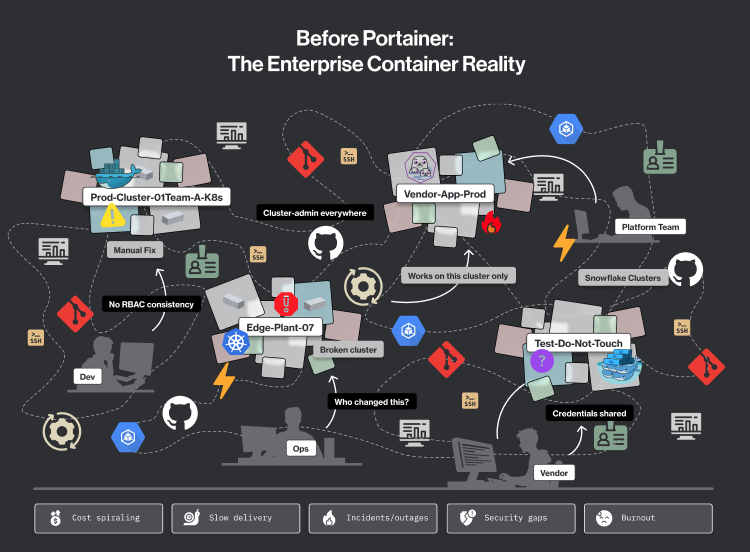
This creates friction between technology and delivery. Short-term workarounds and ad-hoc fixes become necessary to overcome technological hurdles, but over time they lead to loss of control, instability, outages, configuration drift, and growing compliance and security exposure.
The result is predictable: stalled modernization projects, lagging adoption of new technologies, fragile platforms, operational burnout, and rising risk. This is the enterprise container management problem.
What Is Portainer?
Portainer is an enterprise container management control plane.
It sits above Kubernetes, Docker, and container runtimes to provide a consistent, centralized operational model across all environments—cloud, on-premises, and edge.
Instead of treating each cluster as a unique system, Portainer enables organizations to manage container platforms as a fleet, governed by shared policies and operational standards.
Portainer centralizes:
- Identity and access control
- Governance and policy enforcement
- Application deployment workflows
- Auditability and operational visibility
- Multi-cluster and multi-environment management
By doing so, it eliminates “snowflake” clusters, reduces operational toil, and ensures environments remain secure, compliant, and reliable as they scale.
Portainer is designed to be operated by enterprise IT teams, not just Kubernetes specialists.
Core Capabilities
Centralized Governance and Control
- Define access, roles, and permissions once and apply them everywhere
- Enforce consistent policies across clusters and environments
- Maintain continuous alignment with organizational standards
Secure, Auditable Operations
- Full audit logging of configuration changes and deployments
- Clear accountability for access and actions
- Built-in support for compliance and security reviews
Cost-Effective Multi-Cluster Management
- Manage many clusters without linear increases in effort
- Reduce tooling sprawl by consolidating operational functions
- Prevent configuration drift that leads to outages and rework
Controlled Self-Service
- Separate infrastructure governance from application delivery
- Platform teams govern infrastructure without blocking productivity
- Git-based automation for application teams for controlled, consistent, repeatable application delivery across clusters
Broad Environment Support
- Kubernetes distribution-agnostic
- Works across Docker, Podman, and single-node Kubernetes
- Designed for data center, cloud, air-gapped, and edge environments
Business Outcomes
By acting as an operator control plane, Portainer delivers measurable business value:
Lower operational cost
Fewer tools, less manual effort, and no need for large platform teams.
Reduced operational risk
Centralized governance, consistent configuration, and full auditability.
Improved reliability and stability
Fewer outages caused by drift, inconsistency, or undocumented changes.
Sustainable container adoption
Enable container platforms without scaling headcount or expertise requirements.
Security and compliance by design
Governance embedded into daily operations, not bolted on later.
Organizational resilience
Platforms no longer depend on individual heroics or tribal knowledge. Already constrained teams are no longer overloaded.
Works with what you have
Fit-for-purpose operations across regulated, air-gapped, low-bandwidth, low resource, single node and non-Kubernetes environments, designed to work with what you have
How Portainer Works
Portainer introduces a centralized operational control plane above container platforms.
Administrators centrally define:
- Access models
- Governance and security policies
- Cluster configuration across production and non-production
- Operational standards
- Application deployment workflows and constraints
These policies are then applied consistently across all the entire fleet of managed environments, and automatically keeps clusters up-to-date as changes are made, making changes predictable and auditable.
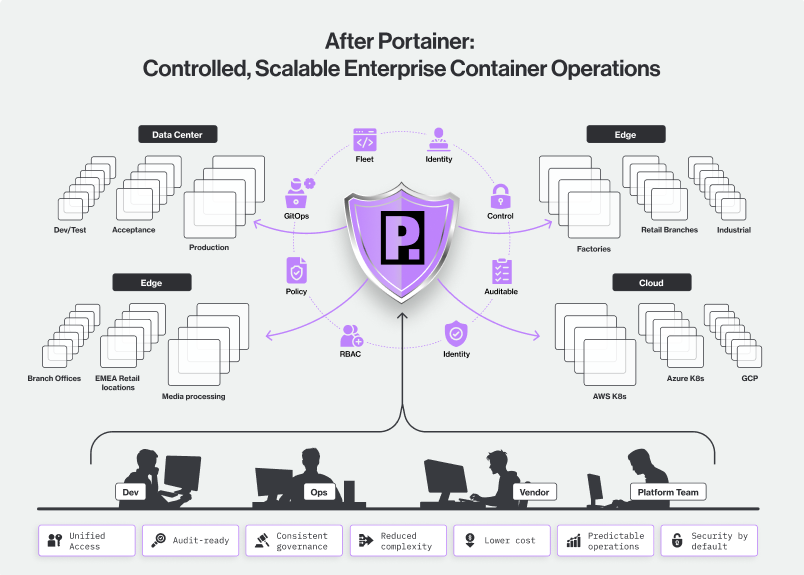
This means greater control and lower risk, while still allowing teams to spin up fit-for-purpose clusters for their specific needs, without losing control. Some environments can be tightly governed. Others can allow more flexibility. All remain visible, controlled, and trustworthy.
By consolidating governance, access, deployment, and fleet operations into a single system, Portainer shifts container platforms from engineering projects into managed operational systems that directly serve business requirements — without any overhead or toil.
Because it is self-hosted and lightweight, it fits seamlessly within enterprise requirements for security, data sovereignty, and control across cloud, on-premises, and edge environments. It does not require a rip-and-replace approach, and compliments existing components – not replace them.
The result is faster, more consistent delivery; lower operational risk; reduced reliance on scarce specialists; and a container platform that leadership can trust as the organization grows and changes.
Who Is Portainer For?
Portainer is designed for enterprise IT organizations where:
- IT is primarily a cost center
- Stability, security, and predictability are paramount
- Teams are composed largely of generalists
- Kubernetes adoption is driven by necessity, not experimentation
- Platforms must operate across diverse and constrained environments
Portainer enables these organizations to adopt containers responsibly—without building bespoke platforms or scaling headcount linearly.
When Organizations Use Portainer
Enterprises adopt Portainer when container platforms become operationally significant, not experimental.
Enterprises adopt Portainer when operating container platforms at scale becomes business critical, and when the stakes are too high to tolerate loss of operational control.
Common triggers include:
Kubernetes Becomes Business-Critical
When clusters support production and even business critical workloads, informal practices no longer suffice. Portainer introduces operational discipline and structure to scale.
Multi-Cluster Sprawl
As clusters multiply across teams and locations, Portainer provides a way to manage them safely as a fleet, allowing teams to own their own environments while staying in control.
Vendor-Driven Container Adoption
When software vendors mandate containers, Portainer enables secure, governed consumption without redesigning IT operations.
Teams manage tools, not deliver outcomes
When teams are overloaded with complex tool chains to manage their environments, Portainer reduces operational surface area and the team’s cognitive load.
Growing Governance and Compliance Pressure
When audits, security reviews, and regulatory requirements increase, Portainer embeds consistency and governance directly into operations.
Edge and Regulated Environments
When containers extend beyond the data center and into the factory, retail locations and other operational technology contexts, Portainer provides consistent control despite limited local expertise, connectivity and resource constraints.
Leadership Demands Predictability
When executives need full operational insights, stable costs, explainable risk, and reliability —not heroics—Portainer institutionalizes control.
Summary
As adoption of container platforms grows and requirements mature, enterprises face the challenge of adapting existing IT operating models to these modern platforms.
Portainer provides the operational control plane that allows them to do so, restoring control at scale without compromising flexibility or speed.