Portainer Solution Overview - Industrial and IoT

Get your copy
Download the PDF to access the full Whitepaper.
Introduction
This document explains how Portainer delivers centralized operational control for container platforms running across factories, fleets, and edge environments.
What is Portainer: Operational Control for Industrial Container Platforms
Secure, predictable operations for containers across factories, fleets, and the edge
Executive Summary
Portainer is a self‑hosted operational control plane for container platforms in industrial and IoT environments. It helps organizations run containerized workloads securely, consistently, and at scale — across factories, facilities, vehicles, retail locations, energy sites, and remote infrastructure — without requiring deep Kubernetes, Docker, or Podman expertise at every location.
Containers are no longer experimental in industrial environments. What began in the data center now directly affects uptime, safety, quality, and revenue as containers move into operational technology (OT). Today, containers underpin production systems, device management platforms, vision systems, robotics, telemetry pipelines, and edge analytics.
Yet most industrial organizations inherit tooling and operating models designed for cloud-native software teams — not for constrained environments, intermittent connectivity, long-lived hardware, strict change control, or small site-level IT/OT teams.
The result is familiar:
- Fragmented clusters and inconsistent configurations
- Manual deployments and updates
- Limited visibility into what is running where
- Weak access control and auditing
- Growing security exposure at the edge
- High operational burden on already-stretched teams
Portainer restores operational control by centralizing governance, access control, application delivery, and fleet management for container platforms running across data centers, factories, and the edge. It allows industrial organizations to treat container platforms as managed infrastructure rather than fragile engineering projects, bringing predictability, safety, and scalability to modern OT environments.
The Industrial Reality
Industrial and IoT environments have very different constraints from traditional IT:
- Sites are geographically distributed
- Connectivity is unreliable or expensive
- Hardware lifecycles are long
- Local technical skills are limited
- Systems must be stable, repeatable, and auditable
- Downtime has physical and financial consequences
Yet containers are increasingly used to run:
- Manufacturing execution systems (MES)
- Industrial gateways
- Vision and quality control systems
- Predictive maintenance software
- Energy management platforms
- Retail and logistics applications
- Device and fleet management services
Without a control plane, container platforms at the edge evolve organically:
- Each site is configured differently
- Updates are manual and risky
- Security policies vary by location
- Access is shared or unmanaged
- No central audit trail exists
- Failures are difficult to diagnose remotely
Over time this creates operational fragility: environments drift, undocumented changes accumulate, vulnerabilities remain unpatched, and scaling to hundreds or thousands of sites becomes unsustainable.
This is the industrial container management problem.
What Portainer Is
Portainer is an industrial-grade container management control plane that centralizes how container platforms are governed and operated across factories, facilities, vehicles, and edge locations.
It sits above Kubernetes, Docker, Swarm and Podman distributions to provide a single operational model across all environments, from central data centers to single-node edge devices.
Instead of managing each site individually, Portainer enables organizations to manage container platforms as a fleet governed by shared policies, deployment standards, and security controls.
Portainer continuously aligns environments with centrally defined configuration and policy, flags drift, and provides a clear operational picture of what is running where, and who changed it.
It is designed for human operators in real-world industrial environments: clear UI, simple workflows, minimal dependencies, and no requirement for Kubernetes, Docker, and Podman specialists at every site.
Core Capabilities
Centralized Governance Across the Edge
- Define access roles and permissions once, apply everywhere
- Enforce configuration standards across sites
- Prevent configuration drift
- Maintain consistent operational behavior across environments
Secure, Auditable Operations, Compatible with Air-Gapped Environments
- Full audit logging of deployments and configuration changes
- Clear accountability across IT and OT teams
- Support for security reviews, incident response, and compliance requirements
Fleet-Scale Management
- Operate hundreds or thousands of sites from a central location
- Group environments logically (by region, factory, customer, device type)
- Apply updates and policy changes safely and repeatably
Controlled Application Delivery
- Standardize how applications are deployed and updated
- Support Git-based delivery for repeatable releases
- Separate platform control from application ownership
- Prevent ad-hoc changes on production systems
Industrial App Portal
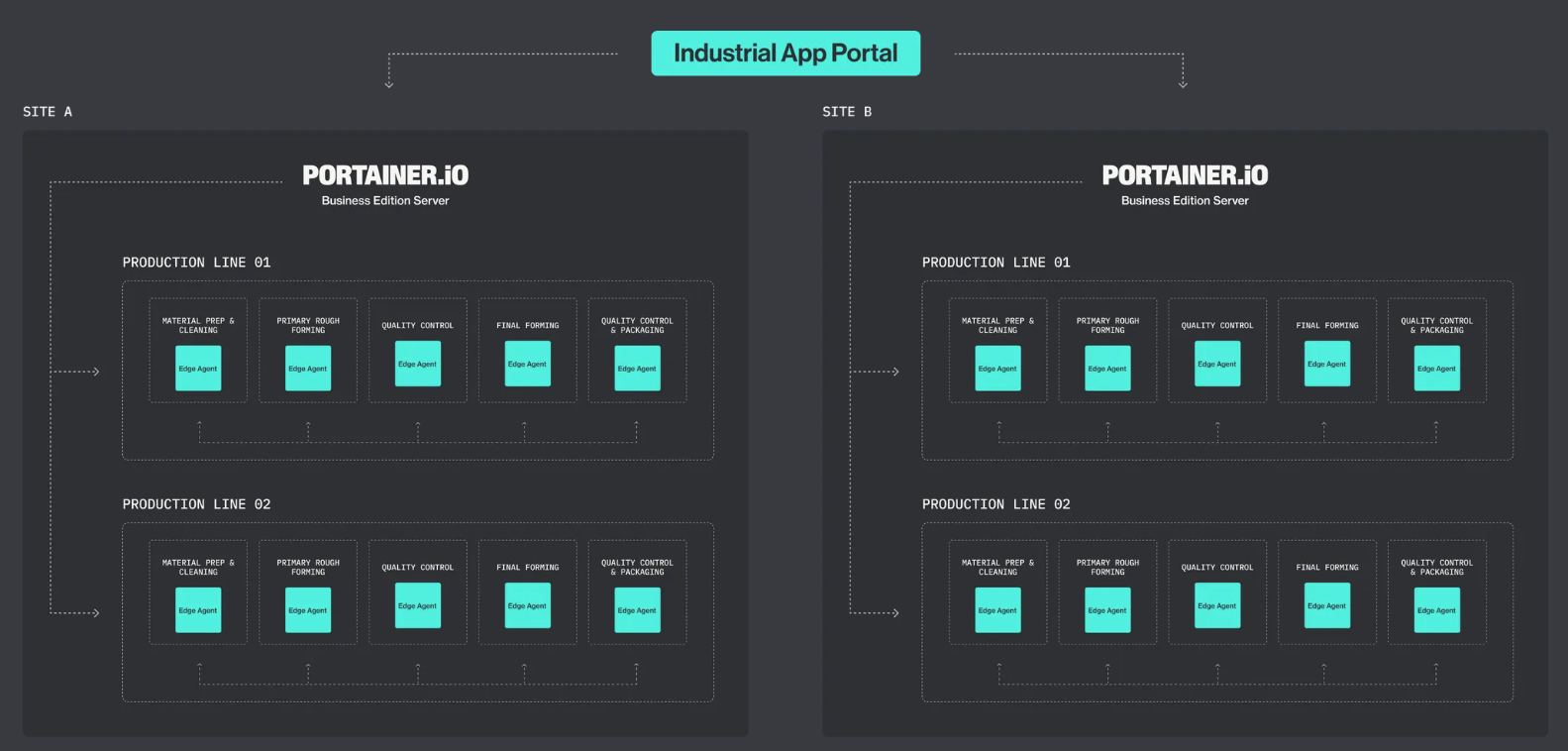
Adding the Industrial App Portal extends Portainer’s governance model to application delivery at the OT edge. It provides a controlled, centrally managed catalogue of approved containerized applications that can be safely deployed at factories and remote sites.
Key capabilities of this optional add-on product:
- Approved application marketplace for operations – publish validated containerized applications (MES components, gateways, vision systems, telemetry services, vendor software) that sites can deploy safely.
- Central governance, local deployment – platform teams control what applications and versions are available, while site teams deploy without needing container or Kubernetes, Docker, and Podman expertise.
- Version control and safe updates – roll out updates consistently across sites, with the ability to stage, test, and control promotion to production environments.
- Reduced vendor and site-level risk – eliminate ad-hoc installs, USB-based updates, and unmanaged third‑party software deployments.
- Designed for disconnected environments – supports air‑gapped and low‑bandwidth locations using synchronized catalogs and controlled release workflows.
Together, Portainer and the Industrial App Portal create a standardized "app store for the factory floor" — combining modern software delivery with the operational discipline industrial environments require.
Designed for Constrained Environments
- Works with intermittent connectivity
- Lightweight footprint
- Supports air-gapped deployments
- Compatible with single-node Kubernetes, Docker, and Podman
- Suitable for low-resource edge hardware
Kubesolo (Single-Node Kubernetes for the Edge)
Kubesolo is Portainer’s lightweight, production-grade single-node Kubernetes distribution designed specifically for industrial and IoT environments.
It provides:
- A full Kubernetes API and workload model on a single device
- Simplified installation and lifecycle management via Portainer
- Predictable upgrades and configuration control
- A consistent platform for vendors and internal teams to target
Kubesolo allows organizations to standardize on Kubernetes where it makes sense, without the operational overhead of multi-node clusters. This makes it ideal for factories, vehicles, retail sites, and other constrained edge locations.
Broad Platform Support
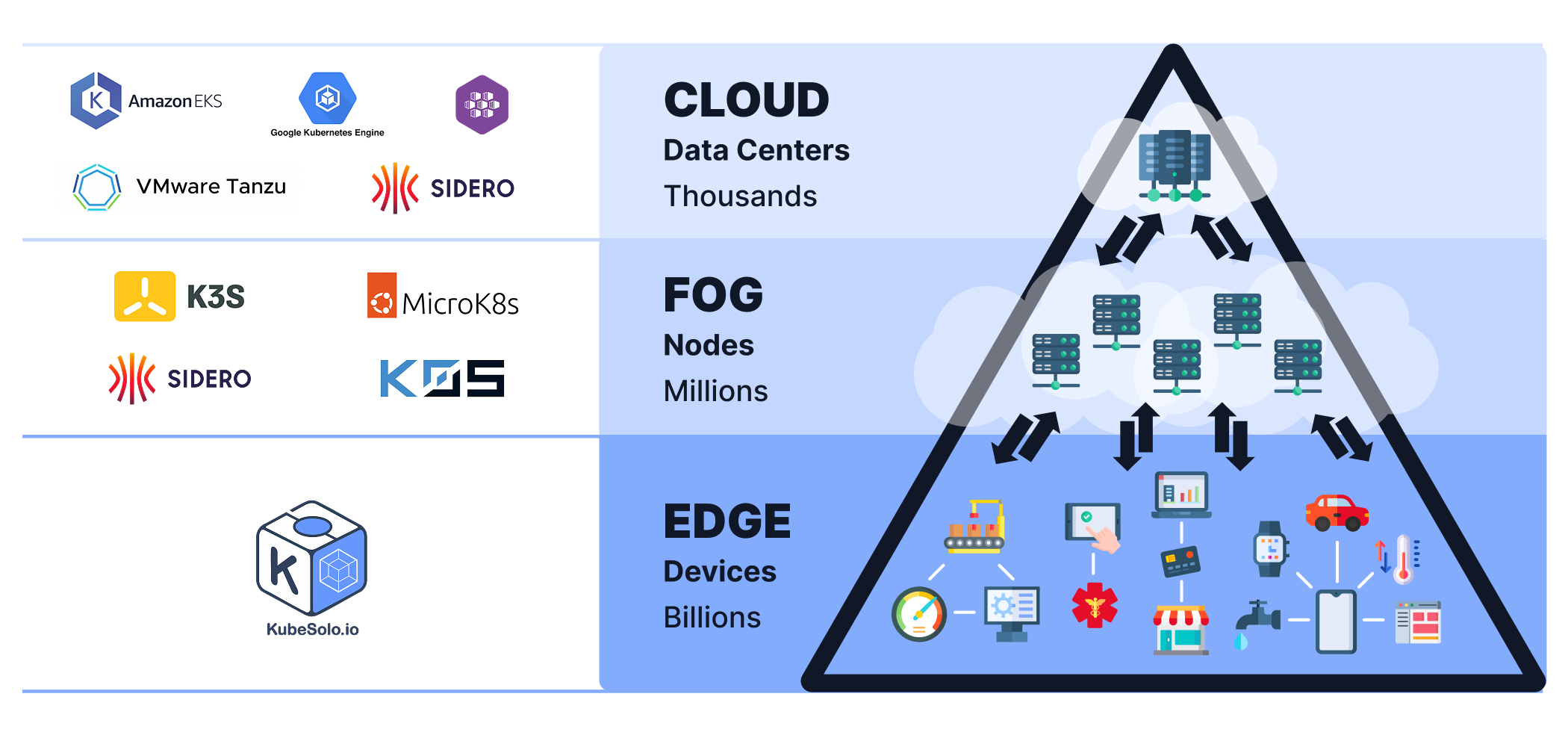
- Kubernetes distribution‑agnostic
- Supports Docker and Podman
- Works across data centers, cloud, and edge locations
Business Outcomes for Industrial Organizations
Operational risk reduction
Consistent configuration, controlled change, and full auditability reduce the likelihood of outages, safety incidents, and compliance failures.
Lower total cost of ownership
Centralized management eliminates the need for custom tooling, site-by-site processes, and large specialist teams.
Faster, safer rollouts
Applications and updates are deployed predictably and consistently across sites without manual intervention or fragile scripts.
Improved security posture
Standardized access control, policy enforcement, and visibility across all locations, including remote and unattended sites.
Increased operational resilience
Operational knowledge is embedded in the platform rather than individual engineers, reducing dependency on undocumented processes or tribal knowledge.
Works with existing infrastructure
Portainer integrates into brownfield environments, mixed hardware, legacy networks, and existing OT architectures. No rip-and-replace required.
How Portainer Works
Portainer introduces a centralized control plane that manages all container environments as a single operational system.
Administrators centrally define:
- Access models for IT and OT teams
- Security and governance policies
- Standard cluster configurations
- Approved application deployment methods
- Operational rules for production vs. non‑production systems
These policies are automatically applied across the entire fleet of environments and kept in sync over time.
Local sites run lightweight agents that communicate outbound to the control plane, making the architecture suitable for NAT, firewalls, and restricted networks.
This allows organizations to:
- Lock down critical production environments
- Grant controlled flexibility for development or testing sites
- Maintain visibility and control everywhere
Portainer complements existing industrial software, device management platforms, and networking architectures; it does not replace them. Portainer provides the operational layer that keeps container platforms safe and manageable at scale.
Who Portainer Is For
Portainer is designed for industrial organizations where container platforms run operational systems
It is a fit where:
- Containers support production, operational, or customer-facing systems
- IT and OT responsibilities overlap
- Teams are small, generalist, and multi-disciplinary
- Reliability, predictability, and control matter more than experimentation
Typical users include:
- Manufacturing groups
- Energy and utilities providers
- Automotive and transportation companies
- Logistics and warehousing operators
- Retail chains
- Hardware and equipment manufacturers
- Industrial software vendors managing customer deployments
These organizations adopt containers to modernize operations, not to build bespoke cloud platforms. Portainer enables them to do so safely, sustainably, and at scale.
When Organizations Use Portainer
Containers move into production environments
When edge workloads become operationally critical and downtime is no longer acceptable.
Site count grows beyond manual management
When tens or hundreds of locations must be operated consistently and securely without site-by-site intervention.
Software updates become risky
When deploying new versions causes outages, regressions, or extended maintenance windows.
Security requirements increase
When unmanaged access and inconsistent configuration become unacceptable risks.
Compliance and auditing become mandatory
When organizations must demonstrate who changed what, where, and when.
IT teams support operational systems
When central teams are responsible for platforms deployed far beyond their physical reach.
Summary
Industrial organizations are increasingly dependent on container platforms to run critical operational systems, from factories to fleets to remote infrastructure.
Portainer provides the missing operational control plane required to govern, secure, and operate these platforms at scale.
It turns distributed container environments into managed, predictable infrastructure — enabling modern software to be deployed with the discipline and reliability that industrial operations demand.