
Share this post
Industrial IoT device management becomes hard when deployments scale beyond a single site. This guide explains what it really means in industrial environments, the challenges enterprises face, and how managing edge workloads keeps operations stable.
We’ll also provide step-by-step guidance on managing industrial IoT through layered architectures, workload control, and edge software operations.
What Is IoT Device Management?
In industrial environments, IoT device management involves reliably operating and controlling large fleets of edge devices at scale. You are managing thousands of devices deployed across factories, plants, substations, and remote industrial sites, where downtime, misconfiguration, or drift directly impact production and safety.
At this level, device management focuses on visibility, standardization, and consistency. You need to know what is running on each device, who can change it, and how updates move across environments without breaking operations. This includes managing the software stack running on industrial edge devices, often containerized workloads that process data locally, integrate with PLCs, or enforce operational logic close to the machine.
Unlike consumer IoT, industrial device management avoids one-off manual access. You standardize configurations, enforce access controls, and apply repeatable operational workflows. The goal is simple: every device behaves predictably, whether it sits on a factory floor, an oil platform, or a remote utility site.
Let’s take a step further and see broader differences between Industrial IoT and traditional IoT device management.
Industrial IoT vs Traditional IoT Device Management
Here are some differences between industrial and traditional IoT
Core Components of IoT Device Management
Industrial IoT device management is a stack of operational components that work together to keep distributed devices reliable, secure, and consistent over time. Each component solves a different management problem, and no single system owns them all.
Device and Hardware Lifecycle Oversight
At the foundation, you manage the physical devices themselves. This includes tracking where devices are deployed, their operational state, and their expected lifespan.
In industrial settings, devices operate in harsh environments with limited physical access, so management focuses on reliability and durability rather than frequent hands-on intervention. The goal is to keep devices operational with minimal disruption to production.
Operating System and Access Control
Above the hardware sits the operating system and basic access layer. Here, management centers on standardizing OS images, controlling remote access, and enforcing least-privilege policies.
You avoid one-off SSH access and undocumented changes. Instead, you maintain consistency across fleets, especially when deploying devices across multiple sites with varying network constraints.
Software and Workload Management at the Edge
This layer manages the applications running on IoT and edge devices, increasingly delivered as containers. You control what runs where, how updates are rolled out, and how workloads recover from failure.
As edge computing grows, this layer becomes crucial for scaling operations safely across distributed environments. This is where modern edge computing platforms and container-based approaches replace manual processes.
Orchestration and Resource Coordination
When devices run multiple workloads, orchestration becomes necessary. This component ensures workloads start in the right order, use resources efficiently, and behave consistently across sites.
Whether lightweight or Kubernetes-based, orchestration introduces structure and repeatability, which is essential in environments that already struggle with operational complexity.
For a deeper look at how this works across distributed sites, the Portainer guide on edge orchestration covers architectural models and platform evaluation criteria worth reviewing.
Further reading: Top Container Orchestration Platforms in 2026
Governance, Monitoring, and Operational Consistency
At the top layer, governance ties everything together. This includes visibility into what is running through a centralized IoT device management dashboard, as well as auditability of changes and alignment with enterprise policies. Implementing strategic fleet device management allows you to define who can deploy, modify, or observe workloads and enforce those rules consistently.
This layer turns device management into an operational system rather than a collection of scripts. Enterprise teams often formalize this through centralized controls because scale and operational risk expose the limits of ad hoc and manual processes.
Managing Software Workloads on Industrial IoT Devices
Industrial IoT depends on software running close to machines and processes, not just devices sending data upstream. Edge workloads handle local analytics, protocol translation, safety logic, and system integration. Managing these workloads effectively keeps distributed industrial environments stable, secure, and scalable.
Standardize How You Package and Deploy Workloads
You start by standardizing how applications are delivered to edge infrastructure. Containers are commonly used because they package dependencies, reduce environmental drift, and behave consistently across sites. This allows teams to deploy the same workload to a factory, substation, or remote site without having to rewrite or reconfigure it each time. The focus is not speed, but repeatability and predictability across heterogeneous hardware.
Side note: This factor is why many organizations adopt a crawl–walk–run approach when introducing containers into industrial environments. See Portainer’s guidance on migrating legacy applications to containers safely.
Control Where Workloads Run and What They Can Access
Once you standardize workloads, define placement and boundaries. Not every application should run on every device, and not every workload should access production systems.
You segment workloads by site, function, or risk profile, then restrict access to networks, storage, and external systems. This strategy reduces blast radius when something fails and supports safer operations across distributed locations.
{{article-pro-tip}}
Contact our sales team to see how enterprises secure their workloads without burning out.
Orchestrate and Coordinate Edge Applications
As edge devices run multiple services, coordination becomes essential. Orchestration ensures workloads start in the correct order, recover from failure, and use limited resources efficiently.
In some environments, this is lightweight scheduling; in others, it involves Kubernetes at the edge. The goal is operational consistency, not architectural purity. In complex environments, edge Kubernetes platforms help teams manage this complexity without exposing every site to full cluster administration.
Govern Changes and Updates Across Fleets
Managing software at scale requires controlled change, not continuous experimentation. You roll out updates gradually, validate behaviour at selected sites, and maintain rollback paths. This protects production systems from widespread outages caused by a single misconfiguration.
A tool like Portainer helps here by providing centralized visibility and role-based access controls, so your team can approve, deploy, and audit changes without logging into devices individually.
Maintain Visibility and Long-Term Operational Stability
Over time, workloads become stateful, interconnected, and business-critical. You need ongoing visibility into what is running, where it runs, and how it behaves under load. This includes understanding storage usage, restart behaviour, and resource contention.
Managing stateful containers and long-lived services at the edge turns IoT software management into a continuous operational practice rather than a one-time deployment.
Examples of Industrial IoT Management Architecture
Industrial IoT management works as a layered system. Devices generate signals, edge infrastructure runs software close to operations, and centralized systems govern how everything is deployed and controlled.
Here are some examples that show how this model works in real enterprise environments:
Digital Production Platform on the Factory Floor
In Volkswagen’s shopfloor integration management (SIM) architecture, every shopfloor device that supports container technology connects to a local container runtime. The local container runtime enables shopfloor applications to run and remain isolated on each device, ensuring low-latency operation and continued production even when central connectivity is limited.
Then, they implemented a management layer (Portainer) that oversees deployments and access, ensuring each factory site runs the same approved software stack while still operating independently.
Portainer centralized workload management, enabling the team to deploy and monitor applications across thousands of devices from a unified interface.
This approach enables scalable software lifecycle management and consistent IT asset visibility across plants.
{{article-cta}}
Industrial IoT at Scale Across Distributed Sites
In large industrial estates, devices are spread across many remote locations. Each site runs edge computing infrastructure to process data locally and integrate with operational systems. Then, there is a central management platform that coordinates workloads, updates, and access policies across all sites.
For example, a leading U.S. building materials manufacturer scaled its IoT and edge deployments across more than 60 plants using centralized container management. Initially, the team struggled to scale containerized workloads across dozens of plants.
They signed up for Portainer, which reduced operational overhead in industrial applications.
Specifically, Portainer transformed the company’s IIoT deployment model by:
- Enabling one-click deployment to all edge cameras and sensors across multiple plants
- Eliminating repetitive command-line operations, allowing data scientists to push updates with just a few clicks
- Using Kubernetes RBAC to secure an air-gapped environment while delivering consistent configurations
- Centralizing container lifecycle management ensured rapid, error-free roll-outs across the entire footprint
This architecture allows enterprises to scale IoT deployments while maintaining operational consistency, even when connectivity is limited or unreliable.
Further reading: Staying Competitive with Industrial IoT at Scale
Partner-Led Edge Integration for Industrial Automation
In partner-driven deployments, industrial controllers and gateways connect to edge infrastructure supplied by automation vendors. Software workloads run locally to interface with PLCs, sensors, and control systems.
Next, a management layer governs the application lifecycle and user access across customer environments.
For example, in partner solutions such as WAGO + Portainer, industrial edge devices run Linux-based controllers with container support. Portainer’s intuitive control plane allows IT and OT teams to jointly deploy, manage, and update IIoT software applications, reducing complexity and bridging the gap between operational and IT tooling.
This separation lets automation partners focus on domain integration while enterprises retain control over software operations and governance.
Key takeaway: Industrial IoT management succeeds when devices, edge compute, and centralized controls are clearly separated yet operationally aligned. This structure keeps local systems responsive while giving enterprises the visibility and governance they need to manage at scale.
Common Challenges in Managing IoT Devices at Scale
Managing industrial IoT environments becomes difficult not because of individual devices, but because of scale, distribution, and operational complexity. Here are common challenges in managing IoT devices for enterprises:
Operational Drift Across Sites
Over time, edge devices stop looking the same. Different software versions, local fixes, and undocumented changes create drift between sites. This gap slows down troubleshooting because no two environments behave identically.
Limited Visibility into What Is Running Where
Many organizations lack a clear, real-time view of workloads across distributed edge infrastructure. Teams often rely on spreadsheets or local knowledge to understand what runs on each device. In large industrial teams, this leads to blind spots, delayed issue detection, and increased mean time to recovery.
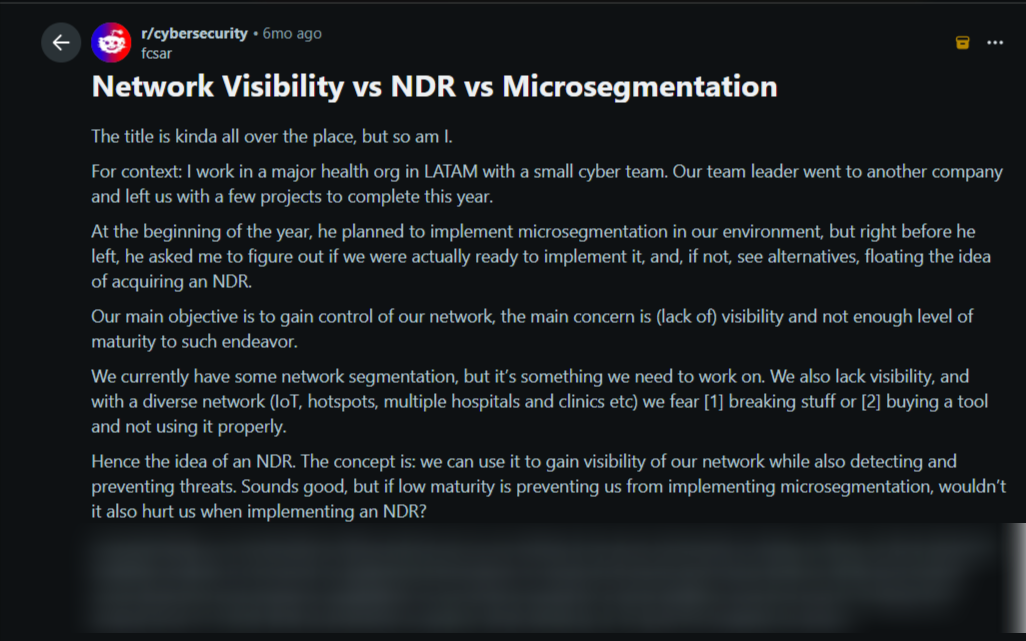
On Reddit, a cybersecurity discussion describes a healthcare organization’s diverse network (including IoT devices in hospitals and clinics) with limited visibility, which risked breaking critical systems during security implementations and required tools like NDR for better monitoring.
Unsafe and Inconsistent Change Management
Rolling out updates across hundreds of edge systems is risky when changes rely on manual access or custom scripts. A single mistake can impact multiple production sites. Often, unmanaged updates cause outages, forcing teams to slow innovation just to maintain operational stability.
Security and Access Control at Scale
As more teams interact with edge systems, controlling access becomes harder. Sharing credentials or granting broad permissions increases risk, especially in regulated or safety-critical environments.
Nokia reported that IoT devices engaged in botnet-driven DDoS attacks are up 500% over the past 18 months and account for 40% of all DDoS traffic. This increase is due to default passwords, outdated software, and inadequate security protections.
Skills Gaps Between IT and OT Teams
Industrial IoT sits at the intersection of IT and operational technology. OT teams understand machines and processes, while IT teams manage infrastructure and software. Without a clear understanding of operational tooling, this gap leads to friction, duplicated effort, and slow adoption of modern edge practices.
Recently, a Redditor noted that automation engineers often lack networking knowledge beyond the basics, creating gaps in the management of IoT-integrated systems, such as PLCs and SCADA systems, in manufacturing.

Run Industrial IoT Operations Without the Burnout with Portainer
Industrial IoT does not fail because teams lack tools. It fails when operations become too fragile, too manual, and too dependent on individual expertise. As edge environments grow, the real challenge is keeping systems stable while letting teams move forward without constant firefighting.
Portainer helps you bring order to industrial IoT operations by giving your teams a single, consistent way to manage containerized workloads across edge and on-prem environments. You reduce ad-hoc access, limit operational drift, and make changes safer without adding process overhead. The result is fewer incidents, faster recovery, and teams that can focus on improvement instead of survival.
Book a Portainer demo to see how enterprises run industrial IoT operations with confidence, predictability, and sustainability.