
Share this post
One failed update across a fleet of hundreds of edge devices, and suddenly you’re scrambling to figure out which site is affected, what broke, and how to fix it without dispatching an engineer on-site. That’s the reality of managing distributed industrial infrastructure without centralized control.
This guide covers what edge devices are, real-world examples of edge device management at scale, and a practical framework DevOps and platform engineering teams use to manage large fleets without burning out or losing operational control.
The Importance of Streamlined Edge Device Management
Edge fleets are growing faster than most ops teams can manually keep pace with. Here’s why centralized management is now a baseline requirement.
Industrial IoT Device Growth Is Outgrowing Manual Management
Connected IoT devices reached 18.5 billion in 2024, growing 12% year over year, and are expected to reach 39 billion by 2030.
The Manufacturing industry leads the growth in this IoT adoption. The sector accounts for 34% of total IoT device deployments in 2025, with the average factory floor running 178 IoT sensors per 10,000 square feet.
Behind every one of those devices is a software workload that needs to be deployed, updated, monitored, and secured. Streamlined edge device management gives your team a single point of control over every workload across every site, so nothing fails as your fleet grows.
Edge Computing Is Now A Core Infrastructure
Global spending on edge computing reached nearly $261 billion in 2025, and experts project it to reach $380 billion by 2028. Industrial IoT applications alone account for over 33% of that spend.
As edge infrastructure moves deeper into remote and uncontrolled environments, the gap between what teams can see and what’s actually running in the field widens. Streamlined management closes that gap, giving teams consistent deployment, monitoring, and control regardless of where devices are physically located.
Unplanned Downtime at the Edge Carries a Price Most Teams Underestimate
Unplanned downtime on edge devices isn’t just an IT problem. It stops production lines, monitoring systems, and safety processes.
ITIC’s 2024 Hourly Cost of Downtime Survey found that a single hour of downtime now exceeds $300,000 for over 90% of mid-size and large enterprises. Four in ten enterprises put that figure between $1 million and $5 million per hour.
Streamlined edge device management reduces these incidents by enabling remote diagnostics, automated rollbacks, and proactive monitoring before failures escalate.
Predictive maintenance systems built on IIoT infrastructure already reduce downtime by 28% on average, but that advantage only holds when the software running those systems is reliably managed at scale.
Challenges of Managing Large Edge Device Fleets
At ten devices, these challenges are manageable. At a thousand, any one of them can take down operations:
These challenges compound as fleet size grows. At 10 devices, workarounds are livable. At 500, they become the primary source of unplanned incidents.
You can explore how automation simplifies fleet device management at scale to prevent these operational bottlenecks.
Examples of Edge Device Management at Scale
These are real organizations, running real fleets of edge devices, that hit the limits of manual management and had to find a better way. Here’s what that looked like in practice:
U.S. Building Materials Manufacturer: From 40 Manual Deployments a Day to One-Click Rollouts
A U.S. manufacturer operating more than 60 plants nationwide was running up to 40 manual container deployments per day across edge cameras and sensors on its factory floors. A single Docker expert handled everything, creating a hard bottleneck that left data scientists unable to push model updates independently.
The company’s data scientist noted:
“Before Portainer, we were running Windows, not Unix, and we had to copy zip files, change the config files, do Docker pulls, and set up the container registry. Each of us was wasting an hour a day (12.5% of a specialized resource’s time).”
The team deployed Portainer for centralized container lifecycle management across all their plants. In return, deployment time dropped significantly, the manufacturer achieved a 12.5% productivity saving, and $100k in annual cost savings.
Most importantly, their time-to-productivity fell from 26 weeks to 5 weeks.
Read the full U.S.-manufacturing company case study.
Volkswagen: Replacing Costly Manual Shopfloor Device Management Across an Entire Brand Group
Before Volkswagen’s Shopfloor Integration Management (SIM) platform, setting up a new shopfloor device meant local maintenance staff installing software via USB, manually configuring the device, and physically resetting it when errors occurred. Across thousands of devices spanning multiple brands in the Volkswagen Group, the cost and effort of that process were substantial.
Volkswagen partnered with Portainer to build SIM, a scalable lifecycle management platform for shopfloor devices.
Every device that supports container technology integrates into SIM, with each component managed as a microservice. IoT applications are now deployed remotely via a centralized interface, providing detailed visibility into each device.
Full local installation now takes two weeks, and vendor lock-in is eliminated through standardized interfaces and container technology. This is a direct result of building on a vendor-agnostic platform like Portainer.
Streaming Radio Provider: 8,000 Channels Across 250 Nodes, No Additional Headcount
A leading North American audio entertainment company needed to manage 8,000+ satellite radio channels across 250 Docker nodes with a five-person Broadcast Engineering team.
And manually updating that infrastructure would require at least two additional full-time engineers, adding $200,000+ in annual staffing costs.
With Portainer, the team centralized container orchestration across all 250 nodes, enabling updates to be pushed from a single interface rather than server by server.
The platform offset 20% of the team’s increased operational workload, delivered $100k in cost savings through automation, and kept millions of subscribers online without adding a single engineer.
{{article-cta}}
How to Achieve Strong, Scalable Edge Device Management
Here’s a practical framework to move from device sprawl to centralized operational control:
1. Build a Complete Inventory of Every Edge Device and Workload
Before managing anything at scale, know exactly what’s running and where. Skip this step, and you’ll spend months tackling issues you can’t trace back to a source.
Start by documenting:
- Every device in your fleet, including location, hardware specs, and connectivity method
- The software workloads running on each device
- Who owns each device, and which team is responsible for it
- The current state of each workload: version, last updated, health status
Most teams discover during this step that their fleet is already inconsistent. In addition, they get to know different software versions running across sites, devices nobody remembers deploying, and workloads with no clear owner.
2. Standardize Your Software Stack Across the Fleet
Inconsistency is the root cause of most edge management problems. When every site runs a slightly different configuration, you never know if an update will hold or if a fix on one site will break another.
Standardization here means:
- Agreeing on a single container runtime across all devices (Docker, containerd, or similar)
- Using a consistent base image for all workloads
- Enforcing the same configuration templates across equivalent device types
- Defining a clear versioning policy so every device knows what version it should be running
With Portainer, you define stack configurations once and push them consistently across every connected edge device, whether you’re managing 20 devices or 2,000.
3. Establish Centralized Visibility Before Anything Else Breaks
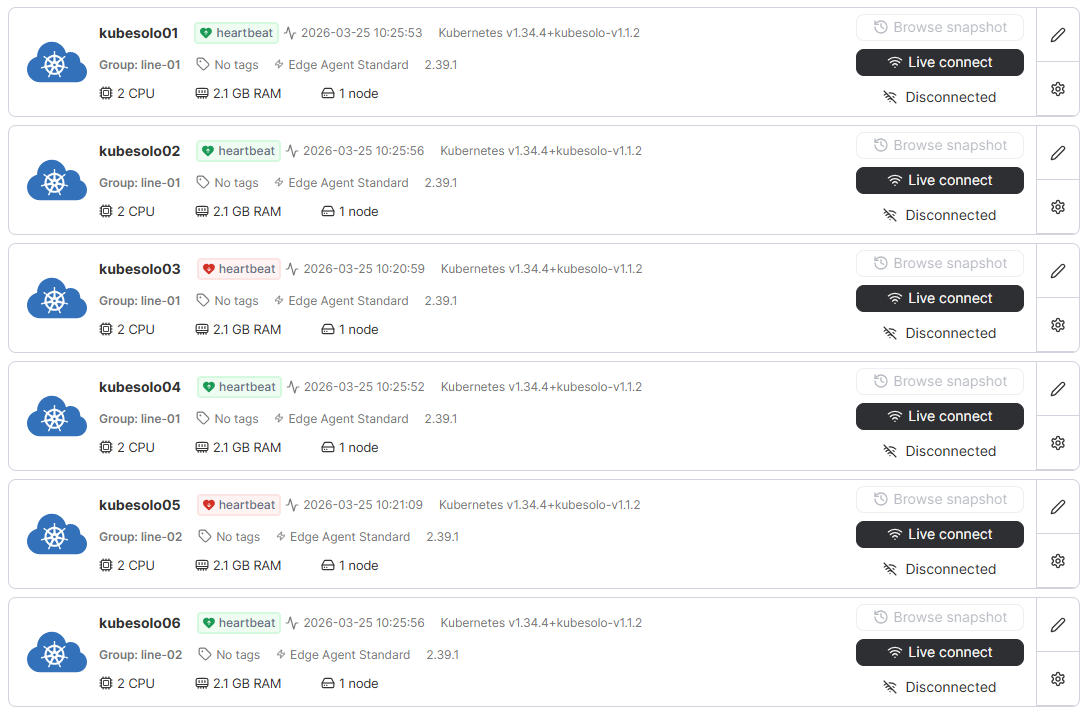
A central visibility dashboard that shows health, status, and activity of every device in the fleet helps you prevent small issues from becoming production failures.
At any given moment, you need to know which devices are online and which aren’t, what version of each workload is running across the fleet, whether any containers are in a failed or restarting state, and when each device was last updated.
Portainer’s edge management dashboard displays these metrics in a single interface across all connected devices, without requiring your engineers to SSH into individual machines or maintain separate monitoring tools per site.
4. Automate Deployments and Updates Across the Fleet
As your fleet grows, pushing updates device by device creates version drift, human error, and engineering bottlenecks that slow down every team depending on that infrastructure.
A scalable deployment process means pushing changes to all devices from one place, rolling updates out to a subset of devices first before going fleet-wide, triggering automatic rollbacks if a deployment causes a workload to fail, and removing manual steps entirely through webhook-based or scheduled update pipelines.
Portainer’s edge stacks and GitOps-compatible deployment workflows let you define what should run and let the platform handle distribution, without writing custom scripts or logging into individual devices.
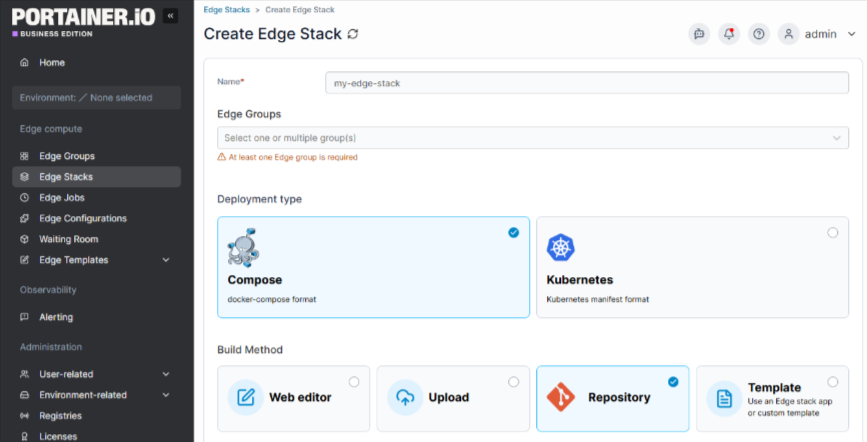
This is where you recover the most engineering time. Automating deployments across 200 devices takes the same effort as automating them across 20. The investment pays back every time an update goes out.
5. Enforce Security and Access Controls Across Every Site
Edge devices run outside traditional data center protections, making software-level security non-negotiable.
A strong security practice at the edge includes:
- Role-based access control (RBAC) so only authorized users can deploy, modify, or restart workloads
- Air-gapped deployment support for environments that can’t connect to external networks
- Regular container image scanning to catch vulnerabilities before they reach production
- Audit logs that record every action taken across the fleet
Portainer’s RBAC model allows you to grant granular permissions to users, teams, or environments.
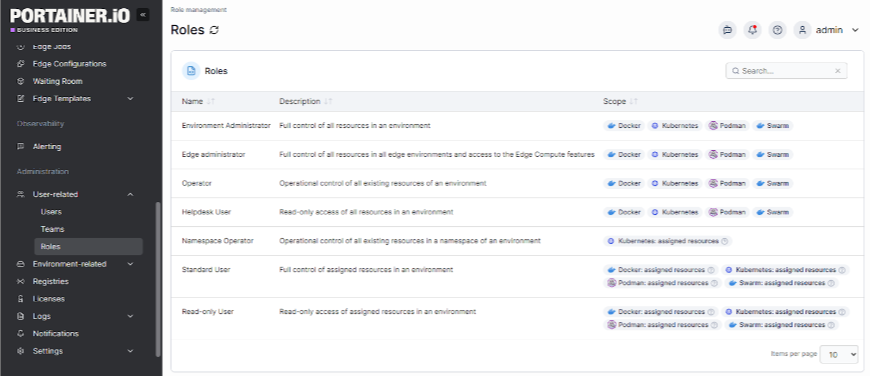
That means your operations staff can monitor and restart containers without touching the deployment configuration. Engineers can also push updates without exposing infrastructure credentials to every team member.
Contact our technical sales team to see how Portainer’s edge management platform gives DevOps teams centralized control over container workloads across every edge device in the fleet.
Choosing the Right Edge Device Management Platform
Use these criteria to evaluate your edge device management options before choosing one:
Portainer offers specific IoT and Edge pricing tiers designed for industrial deployments, including support for air-gapped environments and resource-constrained hardware.
Portainer meets all of these criteria out of the box. It’s a self-hosted management layer, giving your team centralized control over container workloads across every edge device, whether you're running Docker, Kubernetes, or both.
Book a demo to see how enterprise DevOps teams use Portainer to effectively manage their edge devices.
Deploy and Manage Edge Workloads with Portainer
Managing a distributed edge fleet gets harder every time you add a device, a site, or a team member working from a spreadsheet.
Portainer gives you centralized control over every container workload across every edge device, without the complexity of building and maintaining custom tooling.
Unlike cloud-dependent tools, Portainer runs entirely within your network perimeter, so sensitive operational data never leaves your environment, and your fleet stays manageable even in air-gapped or offline industrial sites.
Talk to Portainer’s technical team to see how the platform handles edge device management at scale and what it looks like to run your fleet without the usual operational weight.
FAQs on Edge Device Management
What are Edge Devices?
Edge devices are computing hardware that processes data locally, at or near the source, rather than sending it to a central cloud or data center. Examples include industrial gateways, PLCs, ruggedized servers, smart cameras, and IoT sensors deployed in factories, energy facilities, and remote infrastructure.
What is Edge Device Management?
Edge device management is the process of deploying, monitoring, updating, and securing software workloads across a distributed fleet of edge devices from a centralized platform. For industrial environments, this means maintaining operational control over devices spread across multiple sites without requiring on-site engineering intervention for every change.
Do you need a Container Platform to Manage Edge Devices at Scale?
Not always, but at an industrial scale, container-based management is the most practical approach. Containers standardize how software is packaged and deployed, enabling the simultaneous deployment of consistent workloads across hundreds of devices, instant rollback of failed updates, and security without manual intervention at each site.