Kubernetes Platform Support: Reduce Operational Risk at Scale

Your platform team shouldn’t spend their days firefighting cluster failures, chasing security misconfigurations, and manually pushing Kubernetes upgrades that break production.
For most organizations running Kubernetes without the right support model, that’s exactly what it looks like.
Kubernetes platform support is the operational layer that changes that equation. This guide covers what real Kubernetes platform support includes, why internal teams struggle to deliver it at scale, and how Portainer’s Managed Services close that gap.
What Does Kubernetes Platform Support Really Mean?
Kubernetes platform support is the operational layer that keeps your clusters running when things go wrong. It specifically covers Kubernetes incident response, version upgrades, security patching, and capacity planning.
In practice, that means:
- Someone owns cluster health: Monitoring, alerting, and responding when nodes fail, or pods evict unexpectedly
- Upgrades happen without downtime: Tested rollouts across environments, not manual version bumps that break workloads
- Security patches get applied: CVEs tracked and resolved across every cluster, not just flagged in a report
- Expertise is always available: Senior Kubernetes engineers on call, without you having to hire and retain them full-time
The absence of this support system is what makes your engineers own every failure, including the ones that happen at 3 am.
Why Internal Teams Struggle to Support Kubernetes at Scale
Even enterprise DevOps teams feel the strain once Kubernetes grows beyond a few clusters.
Here’s where many teams usually start struggling:
Talent Shortages and Expertise Gaps
A Redditor asked a question out of frustration: “Why is it hard to hire good DevOps experts?”
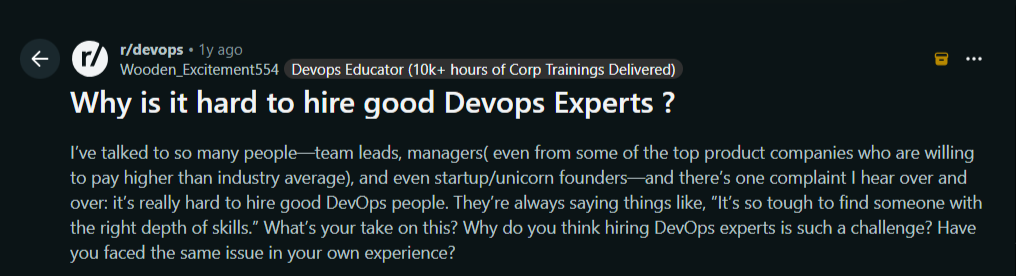
Image: Reddit thread on DevOps expert scarcity
Among other responses, most commenters noted that true proficiency in Kubernetes (beyond basics like kubectl apply) is extremely rare.
A Redditor also explicitly mentioned in another post, “an actual subject-matter expert in Kubernetes seems to be actually rare.”
Kubernetes skills remain scarce. That’s why many organizations rely on a small number of specialists to manage their clusters. When those engineers leave or become overloaded, the entire platform slows down.
The Data on Kubernetes 2025 research report validates this pressure. 40% of organizations report they lack the skills or headcount required to manage Kubernetes environments.
Operational Complexity Grows with Every Cluster
Many companies often start with one cluster and quickly expand to multiple clusters across cloud, on-prem, and edge environments. Each cluster introduces more networking rules, RBAC policies, and infrastructure dependencies.
As the number of clusters and nodes increases, maintaining consistency across environments grows exponentially harder. Most importantly, synchronizing configurations, deployments, and data across distributed containerized environments becomes a daily challenge your team didn’t sign up to tackle.
Upgrade Risks and Configuration Drift
Reddit’s Pi Day outage is the clearest real-world example. A Kubernetes 1.23 to 1.24 upgrade brought the entire site down for exactly 314 minutes.
Reddit’s engineer mentioned that the downtime occurred because an outdated Calico configuration still referenced a node label that Kubernetes 1.24 had silently removed.
Harvey Xia, Reddit’s software engineer, later described their clusters as ‘haunted,’ i.e., drifting so far from their intended state that no engineer could confidently predict how they would behave.
See Portainer in Action
Security Pressure
Beyond day-to-day operations, the same team handling cluster uptime also owns RBAC governance, access policies, container vulnerability patching, cloud cost control, and audit compliance. That’s not one responsibility added to the pile, but an entirely separate workload sitting on the same team.
That pressure accumulates. 89% of organizations experienced at least one Kubernetes-related security incident.
What Kubernetes Platform Support Should Include
Real platform support is a shared-responsibility model in which experienced engineers work alongside your team rather than replacing them. Here’s what that actually covers:
Kubernetes Platform Support Capabilities (At a Glance)
| Support component | What it Covers | Why it Matters |
|---|---|---|
| Platform design | Architecture scoped to your workloads | Avoids technical debt from generic setups |
| Security & access control | RBAC, CVE patching, policy enforcement | Reduces risk of breaches and misconfigurations |
| Upgrade management | Zero-downtime K8s version upgrades | Prevents outages like Reddit’s Pi Day incident |
| Observability and Incident Response | Monitoring, alerting, and on-call escalation | Turns 3 am emergencies into managed events |
| Developer Self-Service | Guardrails for safe application team access | Removes CLI bottlenecks without losing control |
| Disaster Recovery | Backup validation, DR testing, RTO/RPO targets | Untested recovery plans fail when you need them most |
1. Kubernetes Platform Design and Architecture
Generic reference architectures are where most Kubernetes problems start. A platform built for someone else’s workloads rarely fits yours.
Real platform support starts before you deploy your first cluster. That means designing a production-ready architecture scoped to your specific workloads, scale, and risk tolerance, with security, reliability, and operational clarity built in from day one.
As Ranjan Bhagirathan, technical architect at Coda Global, puts it,“Your production clusters must be installed using some automation. It has to be repeatable to guarantee consistency and also helps with recovery when needed.”
That’s exactly the standard Portainer’s Managed Services team builds for enterprise teams. Our engineers design Kubernetes platforms around your workloads, scale, and operational requirements, not a generic starting point.
2. Upgrade Management and Lifecycle Operations
Kubernetes upgrades are one of the highest-risk operations any platform team performs. Skipping them creates security exposure, while rushing them creates outages.
Reddit’s Pi Day post-mortem makes the risk obvious: their backup procedure had been written years earlier, never kept up to date with their actual environment, and never tested against a production cluster. When they needed it, they didn’t know how long the restore would take, and initial estimates ran to hours of guaranteed downtime.
Proper upgrade management means tested rollouts across environments, version compatibility checks before execution, and a restore procedure that’s validated against your current production state, not the one from two years ago.
3. Security, RBAC, and Access Governance
Security in Kubernetes isn’t a one-time configuration, but an ongoing operational practice that most stretched platform teams deprioritize under delivery pressure.
Full platform support covers:
- RBAC governance so access is granular and role-appropriate
- Container image vulnerability scanning before deployment reaches production,
- Policy enforcement across namespaces and clusters, and
- CVE patching tracked and resolved — not just flagged in a report.
89% of organizations experienced at least one Kubernetes-related security incident, with 40% tracing the issue directly to misconfigurations inside their container or Kubernetes environments.
In almost every case, those misconfigurations weren’t introduced intentionally; they accumulated when the platform team deprioritized security work.
4. Observability and Incident Response
Monitoring only application-level metrics leaves cluster-level anomalies undetected until they cause production failures.
That’s why a proper Kubernetes platform support provides full observability, including cluster-level alerting, not just application-level metrics. It means someone qualified receives that alert and responds with defined SLAs, not best-effort availability.
Portainer’s Platform Enterprise tier provides on-call support on a schedule that suits your business (8x5 or 24x7) with one-hour or four-hour response-time SLAs. When service-impacting issues arise, the required engineering capability is already in place to restore service within an agreed timeframe.
5. Developer Self-Service Without Operational Risk
One of the most overlooked costs of poor Kubernetes platform support is the impact on developer velocity. When application teams can’t self-serve, every deployment request flows through the platform team as a ticket. That’s a bottleneck disguised as a process.
That means your developers can ship faster, and your platform team stops acting as a ticking bottleneck.
6. Disaster Recovery Planning and Testing
The most critical component of a successful disaster recovery (DR) strategy is regularly testing and documenting your procedures. Backups are useless without testing recovery procedures, and a DR plan without solid documentation and repeated validation is equally worthless.
Full platform support means defining your Recovery Point Objective and Recovery Time Objective upfront, building automated backup procedures validated against your current environment, and running DR tests on a regular schedule. It’s not waiting for a production incident to discover what doesn’t work.
Portainer’s Managed Platform Services provides experienced Kubernetes engineers alongside your team to handle the complexity of Kubernetes, while your engineers can focus on building.
Talk to the Managed Services team to handle the operational burden of running your Kubernetes clusters.
Managed Kubernetes vs Cloud Managed vs In-House Support Teams
Not all Kubernetes “support” models cover the same responsibilities and the gaps between them are where production incidents happen.
Cloud providers handle the control plane. Internal teams handle everything else. Managed platform services close that gap.
Here are the main differences:
| Capability | In-House Team | Cloud Managed (EKS / GKE) | Managed Platform Service |
|---|---|---|---|
| Control plane management | Fully owned internally | Managed by the provider | Included |
| Worker nodes & workloads | Fully owned | Limited to the control plane | Actively supported |
| Upgrade planning & execution | Manual, risk-prone | Customer responsibility | Planned and validated |
| Security & RBAC governance | Built from scratch | Basic tools only | Pre-configured + enforced |
| Monitoring & incident response | Tool-dependent | Partial visibility | Centralized + proactive |
| Multi-cluster visibility | Hard to standardize | Limited | Unified across environments |
| Operational guidance | Internal knowledge only | Minimal | Ongoing expert advisory |
| Support SLAs | Internal | Infrastructure only | Platform-level SLAs |
| Ideal for | Large dedicated platform teams | Teams wanting minimal control plane ops | Teams that need full operational ownership without growing headcount |
💡 Pro tip: If your team has fewer than 3–4 dedicated platform engineers, in-house support for multi-cluster Kubernetes typically creates more risk than it removes. Cloud-managed services handle the control plane but leave workload operations to you. Managed platform services are the right fit when you need full operational ownership without growing headcount.
Further reading: Managed Vs Unmanaged Kubernetes
See Portainer in Action
Portainer’s Managed Kubernetes Support
Portainer’s Managed Platform Services pairs the Portainer platform with hands-on engineers who design, operate, and continuously improve your Kubernetes environment alongside your team.
Our managed service offers:
1. Proactive Cluster Monitoring and Health Management
Portainer’s engineers don’t wait for alerts to escalate. They support Kubernetes day-2 operations, including lifecycle management, upgrades, and operational guidance to reduce risk and downtime.
That means cluster health is actively maintained, not reactively fixed. Monitoring, alerting, and incident escalation are all covered, so your team stops absorbing every operational signal and starts focusing on building.
2. Upgrade and Lifecycle Management
Kubernetes version upgrades are where most unplanned outages happen. Portainer’s team handles the full upgrade lifecycle: compatibility checks, staged rollouts across environments, rollback strategies, and post-upgrade validation.
The Platform Enterprise tier includes emergency support for service-impacting issues, RCA, and post-mortem analysis after any interruption, and DR planning with continuous validation testing to ensure the platform can be recovered with minimal downtime.
3. Security and Governance Implementation
Our engineers configure and maintain RBAC governance, access policies, and policy enforcement across namespaces and clusters. These actions reduce the risk of production misconfiguration and the pressure on your internal teams to fix every security gap.
4. Multi-Cluster Control With a Unified Platform
Managing multiple clusters across cloud, on-prem, and hybrid environments without a central control plane creates exactly the kind of configuration drift that causes outages.
The Portainer platform supports any CNCF-conformant Kubernetes distribution, including GKE, EKS, and Red Hat OpenShift, without locking you into a single cloud provider.
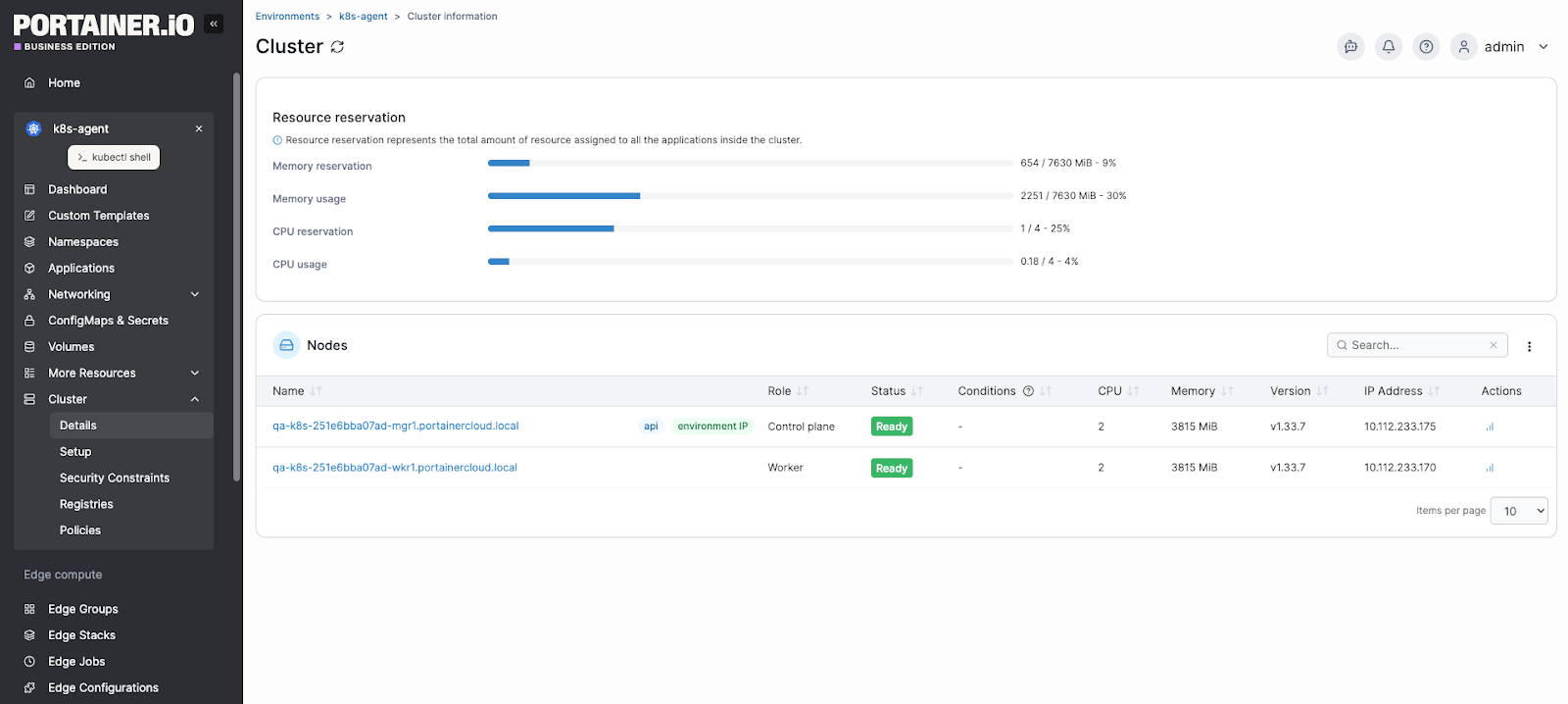
Your platform team can maintain full visibility and governance, while your application team gets safe, self-service access through the Portainer UI.
5. Developer Self-Service Without Operational Risk
With Portainer as the operational foundation, your developers can deploy and manage applications independently through the Portainer UI and APIs. At the same time, Portainer engineers handle cluster design, upgrades, security, and reliability in the background.
6. SLA-Backed Managed Platform Services
Both tiers operate on a shared-responsibility model: Portainer engineers own the operational complexity, and your team retains full control.
Portainer Managed Platform Services offers two tiers: the Platform Plus and Platform Enterprise.
Platform Plus gives growing organizations fractional access to a senior Platform Engineer. It covers platform tooling, SLA and SLO goal setting, CI/CD pipeline configuration, and assisted platform engineering designed for organizations just initiating container adoption who are not yet ready for a full-scale managed service.
Platform Enterprise puts Portainer’s team at the center of your operations as your fractional platform engineering team. It includes on-call support at 8x5 or 24x7 with one- or four-hour response SLAs, proactive platform engineering, automated routine tasks, emergency support, and post-mortem analysis after any service interruption.
Not sure which tier fits your environment? Talk to Portainer’s Managed Services team and get a platform scoped to your workloads.
Reduce Kubernetes Complexity With Portainer’s Managed Services
Kubernetes doesn’t have to mean 3 am incidents, upgrade anxiety, and a platform team stretched across too many responsibilities.
The right support model hands operational ownership to engineers who run Kubernetes every day — so your team focuses on shipping applications, not fighting infrastructure.
If your clusters are growing faster than your team can manage, Portainer’s Managed Platform Services help close that gap.
Talk to the Managed Services team today and run your Kubernetes safely without your team taking on operational risks.
FAQs
What Are Kubernetes Platforms?
Kubernetes platforms are managed environments that abstract cluster infrastructure, providing teams with a controlled, consistent layer for deploying and operating containerized workloads at scale.
When Should Organizations Consider Managed Kubernetes Support?
When internal teams spend more time maintaining clusters than shipping applications. That’s the signal that operational complexity has outgrown available capacity.
Does Managed Kubernetes Support Work Across Cloud and On-Prem Environments?
Yes. Solutions like Portainer’s Managed Platform Services support any CNCF-conformant Kubernetes distribution across cloud, on-prem, and hybrid environments without locking you into a single provider.