Share this post
Your production line cannot afford to wait 300 milliseconds for a cloud server to decide whether a machine needs to shut down. A sensor detects an anomaly, but by the time that signal reaches a remote server and returns with a response, the defective product has already cleared inspection, or worse, the equipment has already failed.
This guide covers how industrial edge computing works, where it delivers the most value, and how to implement it across your operations without adding to your team’s workload.
How Edge Computing in Industrial Applications Works
Industrial edge computing follows a simple four-step flow:
- Data generated: Sensors, machines, and IIoT devices on the factory floor continuously produce data, including temperature readings, pressure levels, vibration metrics, and production counts.
- Processed locally: Instead of sending that data to a remote cloud server, an industrial edge computer on-site processes it in milliseconds.
- Action taken: The edge system triggers an immediate response, such as shutting down an overheating machine or flagging a defective product on the line, without waiting for a round-trip to the cloud.
- Optionally synced to the cloud: Aggregated, non-time-sensitive data gets sent to the cloud for long-term storage, reporting, or deeper analysis.
Why Edge Computing Is Crucial for Industrial Systems?
Industrial edge computing solves problems that cloud-only architectures can’t handle at scale. Here are three specific problems pushing industrial teams toward edge computing:
Latency Kills Precision
Cloud round-trips typically take 100–300ms. Many industrial control systems require sub-10ms response times for safety shutdowns, robotic adjustments, and defect detection.
IEEE research shows edge nodes reduce latency by 82% and cuts bandwidth consumption by up to 65%.
Network Outages Stop Production
Dan White, Director of Technical Marketing at Opto 22, explains it well in the Industrial Ethernet Book.
He said,
“You can’t rely exclusively on cloud platforms like AWS and Snowflake to run a machine on the plant floor. That’s because a simple network outage would cripple your operations.”
Cloud Costs Compound at Scale
IIoT now accounts for the largest share of global edge computing applications at 30% of the market. More sensors mean more data, and cloud-only IIoT costs scale with each one.
Top Use Cases of Industrial Edge Computing
Industrial edge computing applies across manufacturing, energy, agriculture, logistics, and more. Here are the six most impactful edge use cases driving real results today:
Real-Time Quality Control in Manufacturing
Edge computing processes visual data directly on the factory floor. AI models running on local edge hardware flag defects in real time, triggering immediate line adjustments without waiting for cloud round-trips.
For instance, a major American building materials manufacturer deployed AI-powered visual inspection cameras across 21 plants using Docker containers managed by Portainer.
The team used Portainer to deploy a real-time video feed application monitoring drywall boards on a high-speed production line, pushing and pulling updates up to 40 times per day across all plant cameras simultaneously.

This model replaced their fully manual command-line deployments and increased time to productivity from 26 weeks to 5 weeks.
Read the full building materials manufacturer case study.
Predictive Maintenance
Unplanned equipment failure is one of the most expensive problems in industrial operations. A report shows that unplanned downtime now costs the world’s 500 largest companies 11% of their revenue, totaling $1.4 trillion.
Edge devices continuously monitor vibration, temperature, and acoustic data from motors and machinery. Machine learning models running locally detect early failure patterns and trigger maintenance alerts before a breakdown occurs, keeping uptime high without sending constant raw sensor streams to the cloud.
Autonomous and Connected Vehicles
Autonomous vehicles and connected fleet systems generate terabytes of sensor, camera, and LiDAR data per hour, making real-time cloud transmission impossible.
Edge computing on the vehicle or at roadside units processes safety-critical decisions locally, such as obstacle detection, lane correction, and speed adjustments. Only summarized telemetry and flagged events get sent to central systems for review, keeping response times under 10ms where human safety depends on it.
{{article-cta}}
Smart Agriculture and Remote Environmental Monitoring
Farms and remote industrial sites often operate in areas with limited internet bandwidth or intermittent connectivity. Relying on cloud-based processing for irrigation control, soil monitoring, or climate management can cause dangerous delays.
Edge devices deployed in the field process sensor readings locally, triggering irrigation, ventilation, or alerts without needing a live cloud connection. When connectivity returns, summarized data syncs upstream for long-term analysis and reporting.
Warehouse Automation and Logistics
Modern warehouses run conveyor systems, robotic pickers, barcode scanners, and RFID readers simultaneously. Coordinating all of these in real time requires processing speeds the cloud cannot reliably deliver.
Edge computing sits at the warehouse level, processing inventory data, routing decisions, and equipment status locally. This keeps operations running even during network interruptions, reduces bandwidth costs from continuous cloud data transmission, and allows facilities to scale automation without increasing their cloud spend in proportion.
Energy Monitoring and Grid Optimization
Energy companies manage distributed infrastructure across pipelines, substations, and remote extraction sites, often with limited or unreliable connectivity.
Edge computing enables local data aggregation and control decisions at each site. Instead of routing all sensor data through a central cloud platform, edge nodes process it locally, flagging anomalies and executing automated responses in real time.
For example, a prominent North American energy company managing over 300 containers across 15 to 20 Docker Swarm clusters used Portainer to centralize container operations.
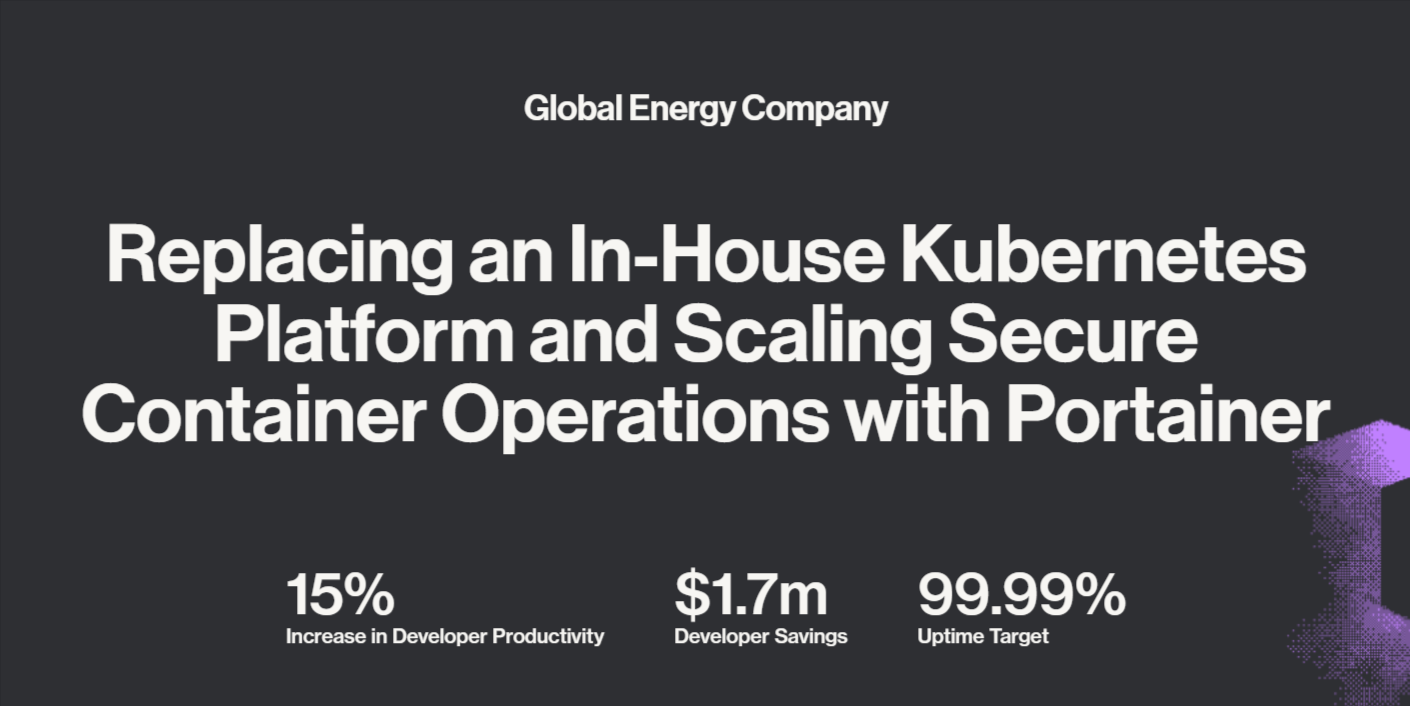
Portainer replaced their $1.7 million internally built Kubernetes platform while maintaining 99.99% uptime targets across distributed environments.
Empower your operations team with Portainer to deploy, update, and monitor edge containers from a single place without 3 am callouts.
How to Implement Edge Computing in Industrial Applications
Follow these steps to move from scattered, reactive operations to a structured edge computing setup that scales:
Step 1: Identify Where Edge Computing Adds Real Value
Before touching any hardware or software, map out your operations and identify where latency, connectivity gaps, or bandwidth costs are creating problems.
Ask two questions:
- Where does a delayed response cause quality failures, safety risks, or production losses?
- Where does sending data to the cloud feel wasteful because the decision only matters locally?
Production lines, predictive maintenance, and robotic control are your highest-priority starting points. Start with one or two, prove the value, then scale.
Step 2: Select the Right Edge Hardware
Not all industrial environments are equal. A food processing plant and an offshore oil platform have very different requirements.
Match your hardware to the environment:
Make sure your chosen industrial edge computer supports the OS and container runtime your software stack needs. Most production IIoT workloads today run on Linux-based devices with Docker support.
Step 3: Containerize Your Applications
Many teams skip this step, and they pay the price later.
Running applications directly on edge hardware ties your software to a specific device configuration. When hardware changes or you need to roll out an update across 50 sites, you face manual reconfiguration at every location.
A Docker container packages everything your application needs to run, so it behaves identically whether it lands on a Siemens IPC in a German plant or an NVIDIA Jetson in a warehouse in Texas. Your software becomes independent of the hardware it runs on.
Keep in mind that Standard Kubernetes is resource-intensive and not suitable for most IIoT hardware. For these environments, Docker is the right containerization layer.
As a best practice, split major functions into separate containers, such as I/O and control loops, data normalization, and cloud communication. This separation means each component can be updated independently without affecting the others.
Step 4: Use a Container Management Platform Like Portainer
Once containers are running across multiple sites, the next challenge is visibility and control. SSH-ing into 30 devices one by one to push an update is not a deployment strategy.
A container management tool like Portainer provides a single interface for deploying, managing, and updating your containerized workloads across every edge device in your fleet.
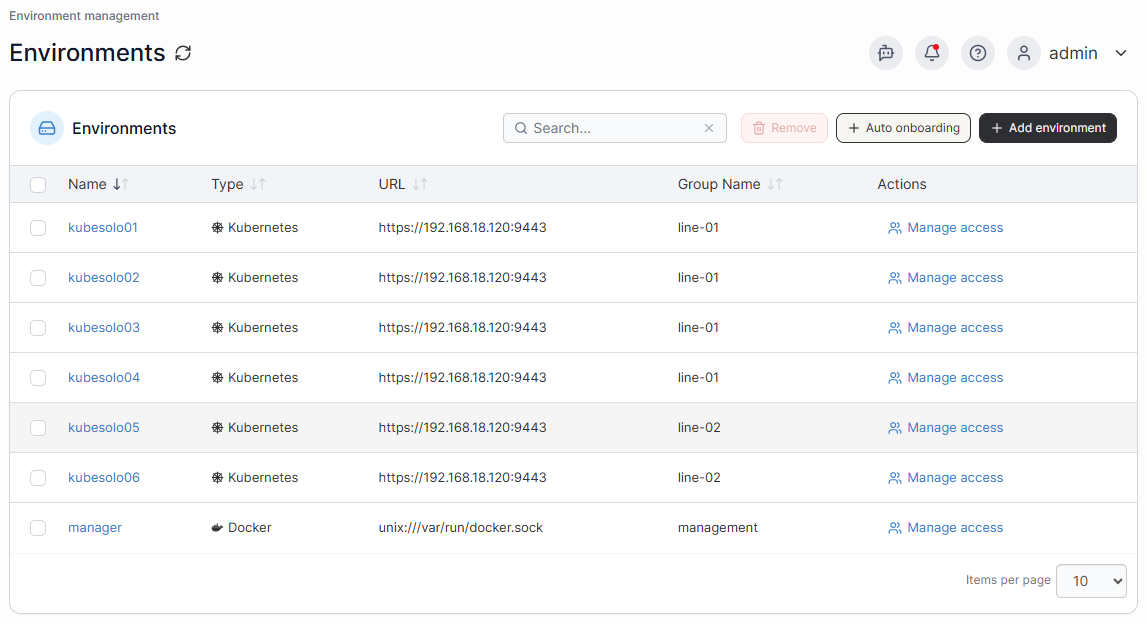
Key Portainer features for IIoT environments:
- Edge Groups: Organize devices by plant, region, or function, then deploy to all devices in a group simultaneously instead of one at a time.
- Edge Stacks: Define your full application stack once and roll it out with staged update controls. Set what percentage of devices receive an update first before it goes fleet-wide.
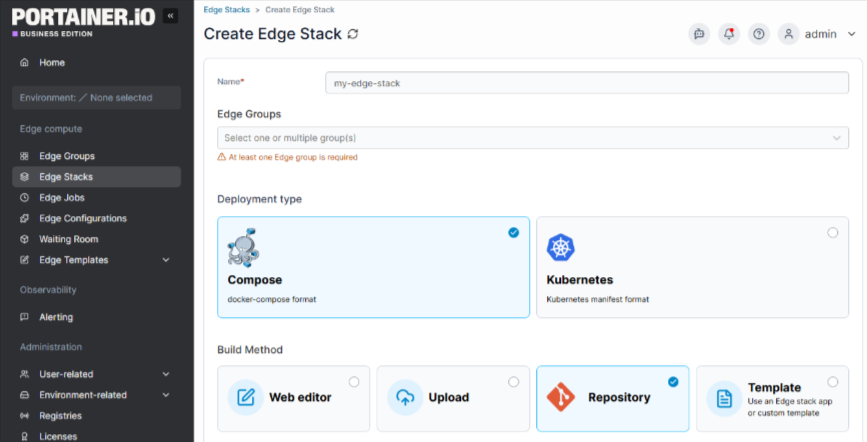
- Update and Rollback: Push Portainer Edge Agent updates to devices remotely and roll back instantly if something goes wrong, no on-site visit required.
- Async Edge Agents: Agents queue and automatically execute workloads, keeping operations running even in remote, intermittent, and low-bandwidth environments.
Book a demo to see how Portainer provides operational control to govern your containers at scale.
Step 5: Define Your Data Routing Strategy
Not all data needs to go to the cloud. Decide locally which data stays at the edge and which gets forwarded upstream.
A practical three-tier model:
- Act locally: Time-sensitive data that triggers immediate responses (safety shutdowns, defect rejection, robotic commands) stays at the edge and never leaves.
- Aggregate locally: Summarized metrics, shift reports, and equipment health trends get processed at the edge and sent to an on-site server or local historian.
- Send to cloud: High-level analytics, long-term trend data, and cross-site benchmarking go to the cloud for centralized reporting and AI model training.
This approach significantly reduces bandwidth costs and keeps operations running during network outages.
Did You Know?
Edge computing can reduce data latency by up to 90% compared to cloud processing, and energy and utility companies that handle data locally at the edge can cut data processing costs by up to 70%.
Step 6: Monitor, Update, and Maintain at Scale
Once deployed, visibility across your fleet becomes the priority. Track these four things across every site:
- Device health: CPU usage, memory consumption, storage capacity, and connectivity status per device
- Container uptime: Which containers are running, which have crashed, and how often restarts are occurring
- Security posture: Who has access to what, when credentials were last rotated, and whether devices are running patched software versions
- Log aggregation: Centralized logs across all sites so your team can diagnose issues without SSH-ing into individual devices
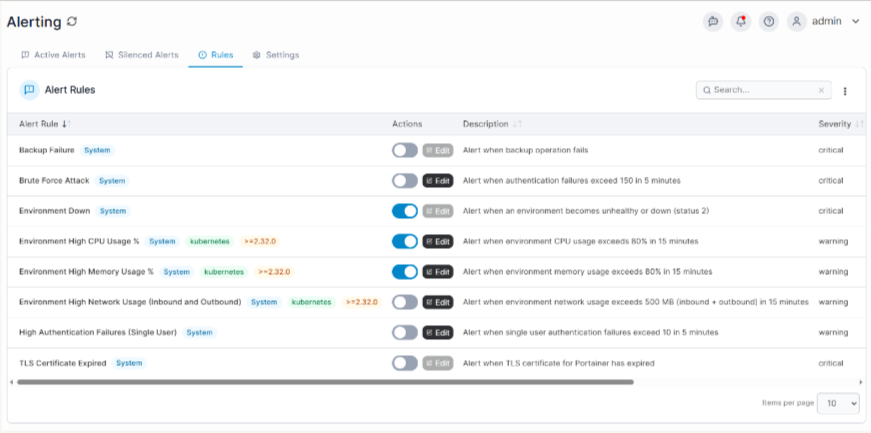
Portainer shows all these metrics from a single dashboard across your entire fleet. Rather than checking devices individually, your team can see the health of every edge environment in a single view and set alert thresholds before a minor issue becomes a line stoppage.
Challenges in Industrial Edge Computing
Every new edge device adds operational complexity. Here is where teams most commonly run into problems:
Contact our technical sales team and centralize container management across every edge device in your fleet.
Choosing the Right Edge Computing Platform
These four features separate an edge computing platform that scales from one that creates more work:
Centralized Multi-Device Management
Managing edge devices one at a time does not scale. Choose a platform that gives your team a single interface to deploy, monitor, and control workloads across every device in your fleet, regardless of location.
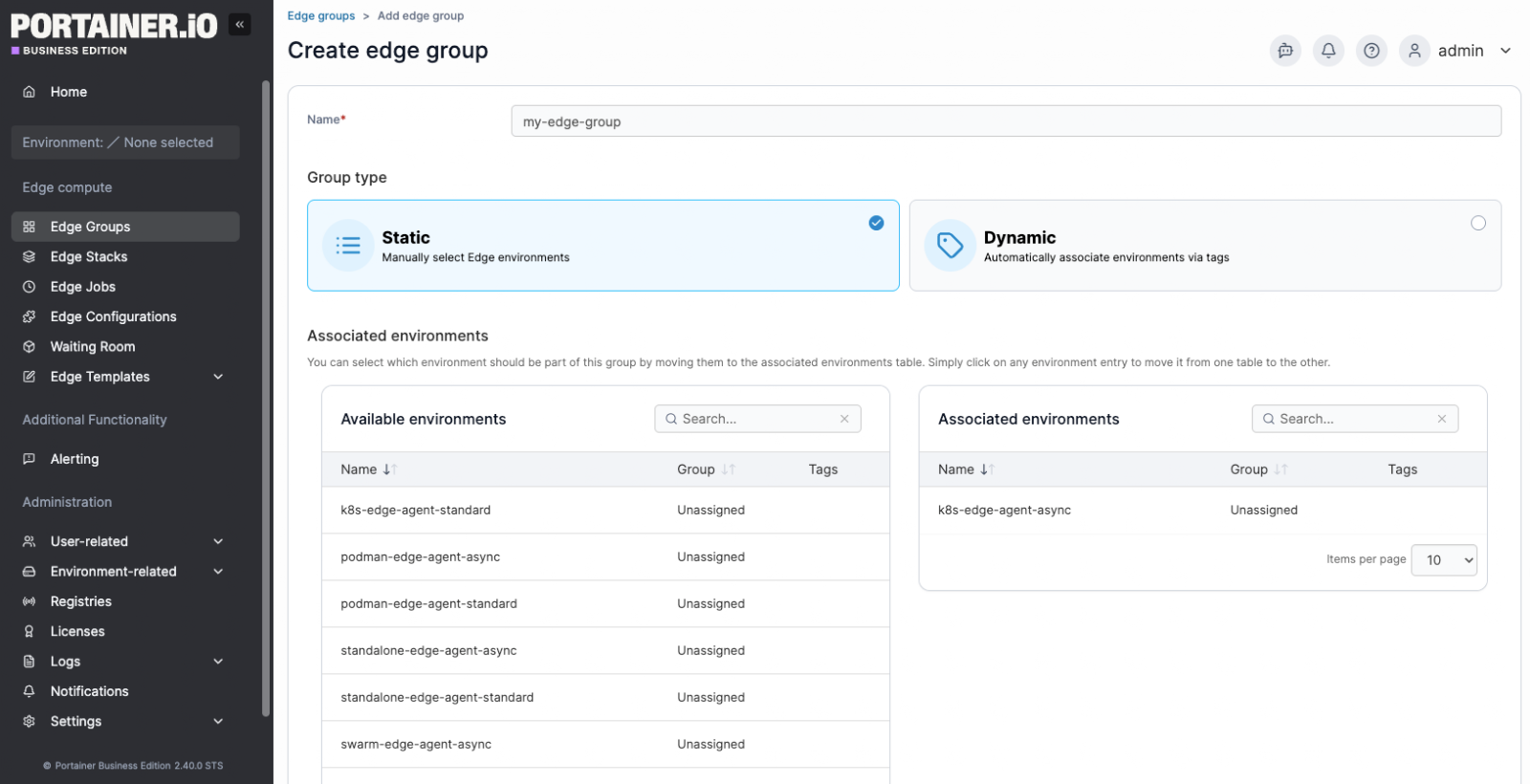
Portainer’s Edge Groups allows you to organize devices by plant, region, or function and act on all of them simultaneously.
Controlled Update Rollouts and Rollback
Your edge computing platform should support staged rollouts, letting you deploy to a subset of devices first and roll back instantly if something goes wrong. Portainer’s Edge Stacks handle both without requiring on-site intervention.
Support for Resource-Constrained Hardware
Industrial edge computers often run on low-power ARM or x86 devices with limited memory and storage. The platform must run a lightweight agent that does not compete with your production workloads for resources.
This is also why Docker, not Kubernetes, is the standard containerization layer for most IIoT environments. A Docker-based stack is far lighter on ARM and x86 edge hardware. Portainer’s Edge Agent is designed to sit alongside it without adding meaningful overhead.
Air-Gap and Security Support
Many industrial environments operate in air-gapped or highly restricted networks. The platform must work reliably without a cloud connection, support RBAC, and give security teams full auditability
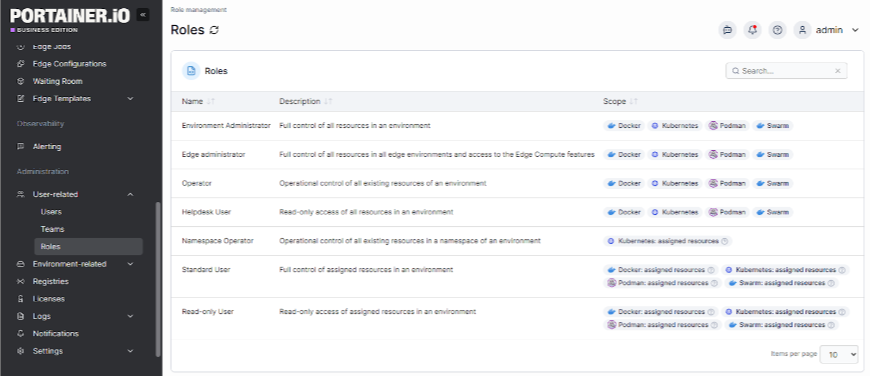
Portainer’s built-in RBAC helps you define exactly who can deploy, modify, or view workloads across your edge fleet. Hence, technicians get the access they need without exposing critical systems to unauthorized changes.
Further reading: Best Edge Computing Platforms
Run and Manage Industrial Edge Workloads Using Portainer
Industrial edge computing closes the gap between data generation and real-time action on the factory floor. But the infrastructure only delivers value when your team can deploy, update, and monitor it without burning hours on manual device management.
Portainer gives your operations team centralized container control across every edge device in your IIoT fleet, from a single dashboard, without requiring deep Linux expertise.
Unlike enterprise Kubernetes platforms that charge per node regardless of workload size, Portainer's edge licensing is designed to scale with fleet-based operations.
See Portainer's IoT and Edge pricing for current tier details and book a demo to see how Portainer works across real edge environments.
FAQs
- What is the difference between edge computing and cloud computing in industrial settings?
Edge computing delivers sub-10ms response times needed for safety shutdowns and real-time control, whereas cloud round-trips typically take 100 to 300ms.
- Do industrial edge devices need a constant internet connection to operate?
No. Industrial edge devices process and act on data locally, keeping operations running during network outages. Cloud connectivity is needed only for syncing aggregated data upstream, not for real-time decision-making on the floor.
- Is Kubernetes suitable for IIoT edge devices?
Sometimes. Standard Kubernetes is too resource-heavy for most IIoT devices. Docker remains the primary containerization platform for resource-constrained industrial edge hardware. That said, lightweight Kubernetes distributions are emerging for IIoT use. KubeSolo, built by the Portainer team, is an ultra-lightweight single-node Kubernetes build designed specifically for edge and embedded environments where full Kubernetes was previously impractical.