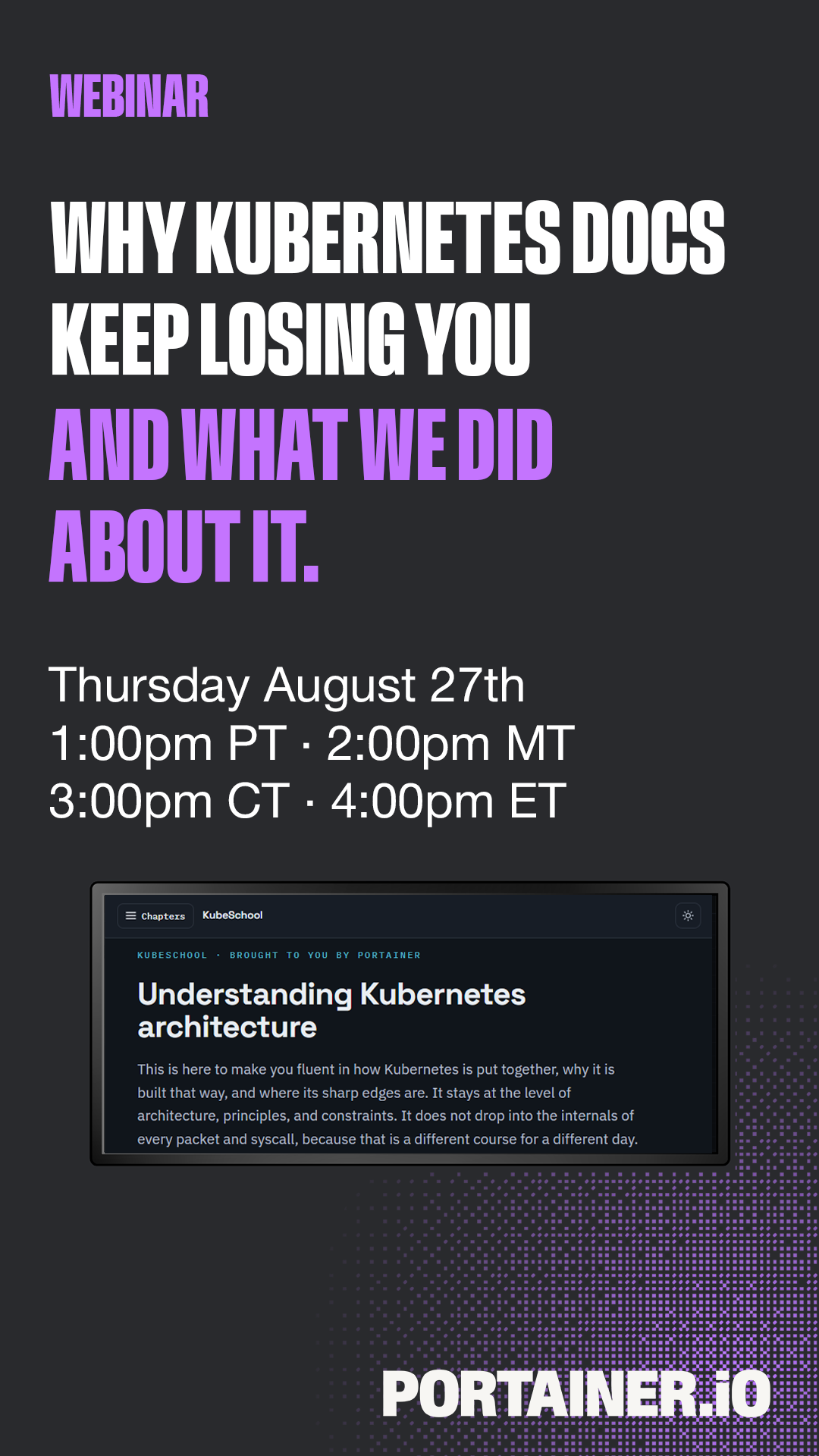
Webinar: Why Kubernetes Docs Keep Losing You (And What We Did About It)
Most Kubernetes explanations fail for the same reason: they hand you commands before they give you the architecture. Join us to find out why that happens, and how a free resource built for one struggling engineer became a theory-first way to actually understand Kubernetes.
Thursday 27 August, 2026 | 1:00 PM Pacific / 2:00 PM Mountain / 3:00 PM Central / 4:00 PM Eastern
Friday 28 August, 2026 | 8:00 AM New Zealand Time
For other timezones, please register and we will send you a link to the recording.
If you've looked at Kubernetes after coming from Docker and quietly closed the tab, or you're partway through a certification path and hit a wall you can't quite name, this session is for you. And it's not because you're not smart enough. Formal training, and most things modeled on it, push you toward the keyboard as fast as possible: learn the commands, get hands-on, feel productive early. The problem is that unless you understand the architecture first, you're memorizing commands you have no real basis for understanding. That's fine if the goal is a certification. It's not fine if you actually want to understand the technology.
That's the gap KubeSchool was built to close. It started when one Portainer engineer asked for help getting his head around Kubernetes, after every explanation he'd been given, internally and externally, went too deep, too fast. Rather than explain it once and have it evaporate, we wrote it down properly, shared it, and it grew from there. What began as a single lesson became a free series covering Kubernetes fundamentals, Helm, GitOps, and observability, plus a systems design primer, because people kept asking for more.
In this webinar, we're not going to teach you Kubernetes. We're going to show you why theory-first understanding beats commands-first memorization, demonstrate the difference live, and be upfront about what KubeSchool is and isn't. No product pitch, no YAML-filled slides, just twenty minutes on why this approach works, followed by open questions.
Key Takeaways
- Most Kubernetes struggle is a sequencing problem, not a competence problem. Being handed commands before architecture is why so much of it doesn't stick.
- Theory-first beats commands-first for real understanding. Certification and formal training optimize for passing an exam, not for grasping how or why Kubernetes works the way it does.
- The same mistake shows up from different starting points. Docker users carry over a single-host, imperative mental model that doesn't transfer, while certification learners memorize objects without the architecture underneath them.
- KubeSchool is not a training course, and it isn't trying to be the definitive Kubernetes resource. It exists to build genuine understanding of the concepts underneath Kubernetes, not to replace hands-on practice or certification.
This Webinar Is for You If
- You've looked at Kubernetes coming from a Docker background and found the concepts didn't map the way you expected.
- You're partway through a certification path and can run the commands but can't explain why they work.
- You lead or mentor engineers ramping up on Kubernetes and want a better way to introduce the fundamentals than a wall of YAML.
- You're curious how a free, unplanned internal resource ended up resonating with the wider Kubernetes community.
Speakers
Neil Cresswell
Founder and CEO
Neil Cresswell is the co-founder and CEO of Portainer, a popular platform that simplifies container management for Docker, Kubernetes, and edge environments. A veteran of over 25 years in IT, he began his career with 12 years at IBM before leading VMware consulting at ViFX across Asia-Pacific and serving as CEO for cloud service providers. Frustrated by the lack of usable tooling for "containers as a service," he created Portainer to make container technology accessible to everyone. Under his leadership, Portainer has grown from an open-source UI into an enterprise-ready platform used globally.
James Carppe
Product Marketing Manager
A former web developer, operations manager, and radio announcer, James is a big fan of technology in all forms. When not making videos and helping Portainer customers out, you'll often find him watching films and television, pretending to be a photographer, and tinkering with the latest gadgets.