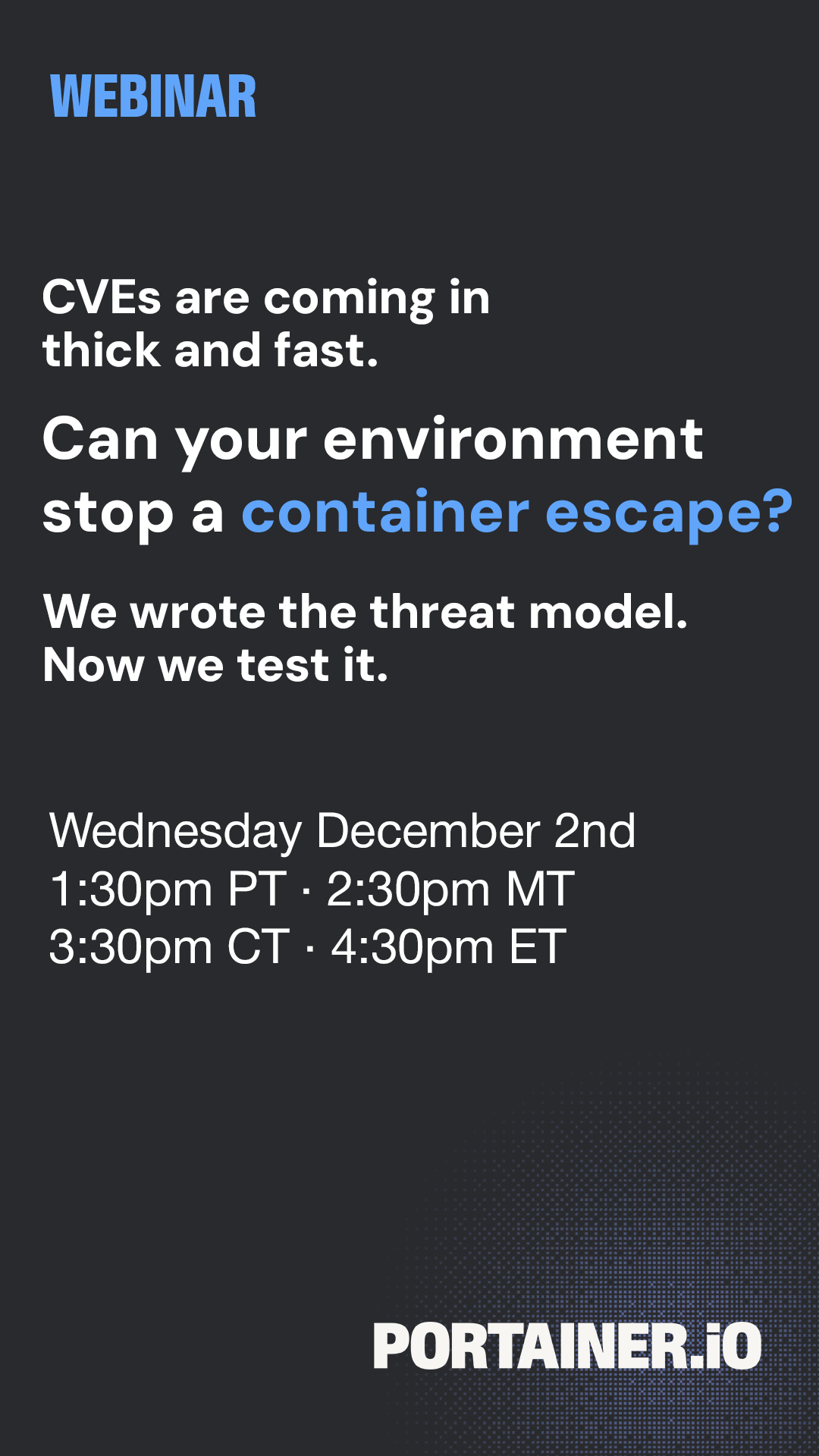
Webinar: CVEs are piling in thick and fast. Can your environment stop a container escape?
Container escapes are real, AI makes them cheaper, and your platform’s assumptions about how often they happen may no longer hold. This webinar tests the claims live.
Wednesday 2 December 2026 | 1:30PM Pacific / 2:30PM Mountain / 3:30PM Central / 4:30PM Eastern
Thursday 3 December 2026 | 10:30AM New Zealand Time
For other timezones, please register and we will send you a link to the recording.
Container escapes stayed rare for years because finding a flaw, writing the exploit, and chaining it into a runtime or kernel escape took scarce skill. An attacker with access to an unrestricted AI model no longer needs any of that. The model reads the dependency list, finds the unpatched flaw, writes the exploit, and chains it to an escape - with the attacker needing to understand neither step. The threat model has changed, and most platforms’ defenses were designed for the old one.
In this webinar we work through Portainer’s Container Platform Threat Model live, on a real lab, so you can see the behavior rather than take it on trust. We deploy a vulnerable application, exploit it from outside, pivot through a mounted Docker socket, and read the host’s credential store from inside a container that had no special flags. The engine executes every step without question. Then we run the same requests against a hardened Kubernetes environment and show what changes: Pod Security Admission refuses the dangerous request regardless of which client submitted it, user namespaces map container root to an unprivileged node user, and NetworkPolicy closes the lateral movement path the flat Docker network leaves open.
The session also addresses the obvious follow-up: what if we just don’t mount the socket? runc has had serious escape vulnerabilities repeatedly since 2019, and three were disclosed in November 2025. These needed no socket and no flags - just a container. Patching closes the known CVE, not the next one. What changes the outcome is the runtime’s blast-radius control, and that is what the second half of the webinar shows working.
Key Takeaways:
- The threat model assumes an escape will happen. An application exploit chained into a runtime escape is now within reach of an attacker who understands neither step. Designing for it is the starting point.
- Much of the risk needs no exploit at all. On a default Docker host, a privileged container, a mounted socket, host PID and a bind mount of the filesystem are legal API calls the engine executes. Anyone - or any AI agent - with socket access can make them.
- A tool in front of the engine can hide an option, but it cannot refuse the request. The engine ships no policy. Portainer renamed its own Docker security settings from “blocking” to “hiding” for this reason.
- Kubernetes decides at the API server, whatever the client. Pod Security Admission refuses dangerous requests from the UI, kubectl and CI alike. The same refusal applies to every client, enforced centrally.
- Hardened Docker and hardened Kubernetes are not equivalent. Rootless Docker limits what an escape yields; it still accepts the request. Kubernetes can refuse the request outright, enforce that centrally, limit lateral movement with NetworkPolicy, and do it without giving up the server features rootless costs you.
This Webinar Is for You If:
- You run workloads on Docker Standalone, Docker Swarm or Podman and want to understand your exposure honestly, not from vendor marketing.
- You’re evaluating a move to Kubernetes and want to know what security controls actually change, and which ones require configuration before they do anything.
- You’re a platform or security lead who has been told your Docker security settings block dangerous requests and wants to verify that claim.
- You’ve read Portainer’s Container Platform Threat Model and want to see the claims tested live rather than taken on trust.
- You want to run the same checks against your own environment after the session.
Speakers:
James Carppe — Product Marketing Manager, Portainer
A former web developer, operations manager, and radio announcer, James is a big fan of technology in all forms. When not making videos and helping Portainer customers out, you’ll often find him watching films and television, pretending to be a photographer, and tinkering with the latest gadgets.
One platform, not twelve tools.
Govern Kubernetes across your whole fleet from a single control plane. Get 3 nodes free.